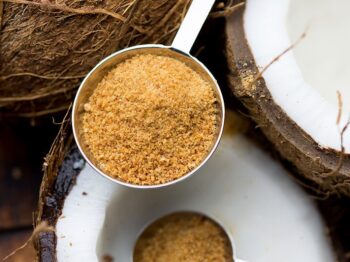
Choosing coconut sugar can support a more sustainable sweetener option when it comes from responsible coconut farming, low-impact processing, and verified supply chains.
Unlike annual crops that may require frequent replanting, coconut palms are perennial trees that can continue producing sap over many years.
However, the environmental impact of coconut sugar still depends on farming practices, processing methods, packaging, transportation, and supplier transparency.
This guide explains the main environmental benefits of choosing coconut sugar and what buyers should verify before using it for retail, food manufacturing, or private label products.
Quick Answer: Why Is Coconut Sugar Considered More Sustainable?
Coconut sugar is often considered a more sustainable sweetener because it comes from coconut palm trees, which are perennial crops that can produce sap for many years.
Coconut farming may also support mixed-crop systems, reduce repeated soil disturbance, and provide income for smallholder farmers.
Still, sustainability is not automatic. Buyers should verify farming practices, certification, processing, packaging, and supplier documentation before making environmental claims.
What is Coconut Sugar?
Coconut sugar, also known as coconut palm sugar, is produced from the sap of coconut palm blossoms.
The sap is collected, heated to reduce moisture, and crystallized into granules.
Because coconut sugar comes from palm sap rather than cane stalks or beet roots, its farming and processing system can be different from conventional refined sugar.
Coconut sugar is still sugar, so its main value in this article is not as a health solution.
The focus here is how coconut sugar production can fit into lower-impact farming, smallholder agriculture, and sustainable sourcing when managed responsibly.
Coconut Sugar vs Conventional Sweeteners: Environmental Considerations
| Factor | Coconut Sugar | Conventional Cane/Beet Sugar |
|---|---|---|
| Crop type | Comes from perennial coconut palms | Often produced from crops that require regular planting cycles |
| Soil disturbance | May involve less repeated soil disturbance | Can involve more intensive land preparation |
| Water use | Often grown in tropical areas with rainfall-based systems | Water demand depends heavily on crop, region, and irrigation |
| Processing | Sap is heated and crystallized | Often requires larger-scale refining and processing |
| Farming system | Can be part of mixed-crop or smallholder systems | Often grown in larger monoculture systems |
| Sustainability risk | Depends on farming, processing, packaging, and shipping | Depends on land use, irrigation, fertilizer, processing, and logistics |
8 Environmental Benefits of Choosing Coconut Sugar
The environmental benefits of coconut sugar depend on how the coconut palms are farmed, how the sap is processed, how the product is packaged, and how transparent the supplier is.
The points below explain why coconut sugar can be part of a more sustainable sweetener choice when it comes from responsible and well-documented supply chains.
1. Perennial Coconut Palm Farming

Coconut sugar comes from coconut palm trees, which are perennial crops. Instead of harvesting and replanting the whole crop every season, farmers tap the sap from coconut palm blossoms while the tree continues to grow and produce.
This tree-based system may reduce repeated soil disturbance compared with some annual cropping systems.
When coconut farms are managed responsibly, perennial coconut palms can support long-term agricultural production while helping maintain tree cover in tropical farming areas.
2. Potentially Lower Water Pressure in Suitable Growing Areas
Coconut palms are commonly grown in tropical regions where rainfall supports growth. In suitable growing areas, this can reduce dependence on intensive irrigation compared with crops that require more managed water input.
However, water impact should not be treated as the same in every country or farm. The water footprint of sweeteners can vary by crop, origin, climate, and agricultural system.
Because of this, coconut sugar should be described as having lower water-pressure potential in suitable environments, not as automatically water-free or impact-free.
3. Tree-Based Farming and Carbon Considerations
Coconut palms are tree crops, and maintaining productive tree-based farms can help preserve agricultural tree cover.
This matters because farming systems with trees can provide environmental functions that are different from open-field monoculture systems.
Still, the actual carbon footprint of coconut sugar depends on land management, processing energy, packaging, transportation, and export logistics.
For this reason, it is safer to discuss coconut sugar as part of a tree-based farming system rather than claim that every coconut sugar product has a lower carbon footprint.
4. Biodiversity Support in Mixed-Crop Systems

Coconut farms can be part of mixed-crop or agroforestry systems where crops such as cacao, coffee, bananas, spices, or root crops grow alongside coconut trees.
FAO explains that agroforestry can diversify yield and income, enhance food security, and increase farm resilience, which supports the logic behind mixed-crop coconut farming when it is managed responsibly.
Mixed-crop systems may also help create habitats for beneficial insects, support natural pest balance, and provide farmers with more than one income source.
However, the biodiversity value still depends on how the farm is managed, whether chemical inputs are controlled, and whether surrounding habitats are protected.
5. Soil Health and Erosion Control
Coconut palms can help support soil stability because they are long-term tree crops. In well-managed farms, fallen leaves and other organic matter can be returned to the soil, helping maintain soil structure and moisture.
This benefit is strongest when farmers use responsible soil management practices.
If a farm relies on poor land management, excessive chemical inputs, or removes organic matter without replacement, the soil benefit may be reduced.
6. Lower Chemical Input Potential
Some coconut sugar producers use organic, low-input, or traditional farming practices.
According to FAO, organic agriculture promotes agro-ecosystem health and avoids artificial chemical fertilizers and pesticides, which is relevant when coconut sugar is supported by valid organic certification and supplier documentation.
However, buyers should not assume that every coconut sugar product is organic or low-chemical by default.
For B2B sourcing, chemical input claims should be verified through certification scope, farm information, product specification, and supplier documentation.
7. Support for Smallholder Farming Communities

Coconut farming is closely linked with smallholder farming communities in many tropical countries, including Indonesia, the Philippines, Sri Lanka, and India.
When coconut sugar is sourced responsibly, it can help create added value from coconut palm sap and support rural livelihoods.
For buyers, the social benefit should still be verified. Responsible sourcing means checking supplier transparency, farmer relationship, fair purchasing practices, traceability, production capacity, and export readiness.
8. Simpler Processing and Responsible Packaging Opportunities
Coconut sugar production generally involves collecting coconut palm sap, heating it to reduce moisture, and crystallizing it into granules. Compared with highly refined sweeteners, this can be a simpler production process.
However, packaging and logistics still matter. A coconut sugar product is not automatically sustainable only because the ingredient is less processed.
Buyers should also review packaging materials, bulk packing options, shelf life, shipping distance, and supplier documentation.
What B2B Buyers Should Verify About Sustainable Coconut Sugar
For importers, distributors, food manufacturers, private label buyers, and procurement teams, sustainability claims should be supported by documentation.
Buyers should not rely only on general claims such as “eco-friendly” or “sustainable” without checking supplier practices and product documents.
Before sourcing organic coconut sugar, buyers should review certification scope, product specifications, packaging options, COA availability, traceability, MOQ, export documentation, and supplier communication.
This helps ensure the product fits both sustainability goals and commercial requirements.
If you are evaluating organic coconut sugar from Indonesia, review the organic coconut sugar specifications and request a coconut sugar COA before confirming a bulk order.
For a broader discussion, read our complete guide on the sustainability of coconut sugar.
Need organic coconut sugar for sustainable product development or bulk supply? Contact our export team to request specifications, certification details, samples, or a quotation.
Final Thoughts
Choosing coconut sugar can support a more sustainable sweetener option when it is sourced from responsible farms, processed carefully, and supplied with transparent documentation.
Its potential environmental benefits include perennial coconut palm farming, mixed-crop systems, reduced soil disturbance, and support for smallholder communities.
However, sustainability depends on real farming practices, processing, packaging, and logistics.
For both consumers and B2B buyers, the best approach is to look beyond general claims and verify how the coconut sugar is produced, documented, and supplied.