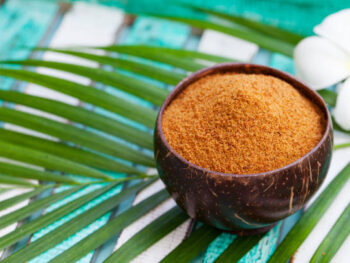
Coconut sugar and white sugar are both added sugars, but they differ in source, processing, flavor, color, and how they behave in some recipes.
Coconut sugar is made from coconut palm flower sap and has a brown color with caramel-like notes, while white sugar is highly refined sucrose with a neutral taste.
Nutritionally, the difference at normal serving sizes is smaller than many marketing claims suggest.
Quick answer: choose coconut sugar when you want a less-refined ingredient, deeper caramel flavor, darker color, or a coconut-sap origin story. Choose white sugar when you need neutral sweetness, a light final color, or very predictable behavior in delicate applications. Neither should be treated as a “free” sugar from a health perspective.
| Comparison | Coconut Sugar | White Sugar |
| Source | Sap from coconut palm blossoms | Sugarcane or sugar beet |
| Color | Golden to brown | White |
| Flavor | Caramel-like, earthy, mildly toasty | Clean, neutral sweetness |
| Calories & carbs | Very similar per typical serving | Very similar per typical serving |
| Glycemic index | Reported values vary; often lower than white sugar | Typically higher than reported coconut sugar values |
| Processing | Sap collection, concentration, crystallization and drying | Extraction, purification, crystallization and refining |
| Best fit | Flavor-forward, natural-positioned and darker products | Light-colored products and neutral sweetness |
What Is Natural Coconut Sugar?

Coconut sugar, also called coconut palm sugar or coconut blossom sugar, is made from sap collected from the flower of the coconut palm (Cocos nucifera).
The sap is concentrated by heating until it thickens and crystallizes, then the sugar is dried and granulated.
A 2019 study analyzing coconut blossom sugar samples described caramel-like aroma and taste as characteristic sensory features and documented that product composition can vary between samples and producers.
Coconut sugar should not be confused with generic palm sugar, which can be made from other palm species. For that distinction, see our coconut sugar vs palm sugar guide.
What Is White Sugar?

White sugar, or table sugar, is refined crystalline sucrose commonly produced from sugarcane or sugar beet.
Its refining process removes most of the color and non-sugar compounds from the original plant material, giving it a clean appearance and neutral sweetness.
Because it is highly standardized, white sugar is often used as the baseline sweetener in food production and recipe development.
Coconut Sugar vs White Sugar: 7 Key Differences
1. Glycemic Index: Do They Affect Blood Sugar Differently?
Coconut sugar is often reported as having a lower glycemic index than white sugar, but published values for coconut sugar vary by product, testing method, and source.
That variation is important: a single GI number should not be treated as universal for every supplier or every finished food.
For a deeper discussion of the reported GI range, testing limitations, and what manufacturers should verify before making a GI-related claim, see our dedicated glycemic index guide.
Important context: a lower GI does not make coconut sugar “free” or automatically suitable for people managing diabetes. Coconut sugar is still an added sugar and still contributes carbohydrates and calories.
2. Nutrition: The Differences Are Smaller at Normal Serving Sizes
Coconut sugar retains minor non-sugar compounds from coconut sap and can contain small amounts of minerals and other naturally occurring components.
White sugar is much more purified and is primarily sucrose.
However, the practical nutritional difference at the amount most people use in a drink or recipe is modest.
Coconut sugar should not be chosen as a meaningful source of minerals, fiber, or micronutrients because doing so would require consuming more added sugar.
That distinction is useful for both consumers and brands: coconut sugar can support a less-refined ingredient story, but it should not be marketed as a nutrient-dense health food.
3. Sweetness and Flavor: Similar Sweetness, Different Character
Coconut sugar is not simply “sweeter” than white sugar. In practical use, their sweetness can feel broadly comparable, but coconut sugar has a more noticeable flavor profile.
Coconut sugar typically brings caramel, butterscotch, roasted, or earthy notes. White sugar provides cleaner sweetness with little flavor of its own.
This difference matters in coffee, chocolate, granola, sauces, cookies, snack bars, and other products where a deeper sugar flavor can complement the formula.
In light-colored cakes, white frosting, meringues, or delicate beverages, white sugar may be preferable because coconut sugar can darken the finished product and add a stronger flavor signature.
4. Sugar Composition: Both Are Still Sugar

White sugar is highly purified sucrose.
Coconut sugar also contains a high proportion of sucrose, together with smaller amounts of other sugars and naturally occurring compounds that vary by sample and processing.
The key takeaway is not that one suddenly stops being sugar.
Both products contribute free or added sugars when used as sweeteners in food and beverages, so portion size and total dietary intake still matter.
The World Health Organization recommends limiting free sugars to less than 10% of total daily energy intake, with a further reduction below 5% offering additional health benefits.
5. Processing: Coconut Sugar Is Less Refined, but “Less Processed” Is Not the Same as “Health Food”
Coconut sugar is produced by collecting coconut flower sap, concentrating it, and allowing it to crystallize into granules.
White sugar undergoes additional purification and refining steps to create a nearly uniform white sucrose crystal.
For buyers focused on natural positioning, ingredient storytelling, or minimally refined sweeteners, this difference can be commercially meaningful.
But processing level alone does not determine whether a sweetener should be consumed in large amounts.
6. Color and Product Appearance

Coconut sugar ranges from golden brown to darker brown depending on raw material and processing.
That color transfers into many finished foods, which can be an advantage in chocolate, granola, cookies, sauces, spice blends, and brown baked products.
White sugar is better suited to products where manufacturers need a pale or transparent appearance.
This is one reason the “best” sugar depends on the application rather than a universal winner.
7. Baking and Culinary Use
Coconut sugar can replace white sugar in many recipes, but this comparison page should not be treated as a universal substitution formula.
Color, flavor, particle size, moisture balance, and the type of recipe can all affect the result.
For exact replacement ratios and recipe adjustments, use our dedicated guide to substituting coconut sugar for white sugar.
Keeping the detailed substitution instructions on that page also prevents overlap between the two search intents.
Coconut Sugar vs White Sugar for Food Manufacturing
For food manufacturers, the difference goes beyond nutrition.
Coconut sugar can change the flavor, color, positioning, and processing behavior of a finished product, so it should be evaluated as an ingredient specification—not just as a “healthier sugar.”
| Formulation factor | Coconut sugar | White sugar |
| Flavor impact | Adds caramel/roasted character | Neutral baseline sweetness |
| Color impact | Darker finished product | Minimal color contribution |
| Ingredient positioning | Useful for natural, organic, less-refined or origin-based positioning when claims are valid | Conventional, standardized sweetener |
| Consistency requirement | Buyers should verify color, moisture, mesh/particle size and batch consistency | Highly standardized commodity specifications |
| Documents to review | Specification, COA, relevant organic/food-safety documents if required | Specification and supplier quality documentation |
If you are evaluating coconut sugar for commercial production, review the current organic coconut sugar specifications and confirm the required moisture, mesh size, color, product form, packaging, and documentation with the supplier before approving the ingredient.
Is Coconut Sugar Actually Healthier Than White Sugar?
The most accurate answer is: coconut sugar has some compositional and processing differences, but the overall nutritional advantage is modest at typical serving sizes.
It may have a lower reported GI and retains minor compounds from coconut sap, but it still supplies sugar, carbohydrates, and calories.
That is why we would not describe coconut sugar as “safe for unlimited use,” “diabetic-friendly,” or a meaningful source of vitamins and minerals.
A more defensible comparison is that coconut sugar offers a different origin, less-refined processing, a deeper flavor profile, and different product-positioning possibilities.
Which Should You Choose?
| Your priority | Better fit | Why |
| Neutral sweetness and light color | White sugar | It has minimal flavor and color impact. |
| Caramel-like flavor and darker color | Coconut sugar | Its sensory profile is more pronounced. |
| Less-refined / coconut-sap origin positioning | Coconut sugar | The production story and origin can support product positioning when claims are accurate. |
| Standardized commodity functionality | White sugar | It is highly standardized and widely used as a formulation baseline. |
| Low-carb or keto formulation | Neither | Both are carbohydrate-rich sugars. |
| B2B organic coconut sugar sourcing | Coconut sugar | Use verified certification, specifications, COA, and supplier documentation rather than relying on generic health claims. |
Source Organic Coconut Sugar from Indonesia
For food manufacturers, importers, distributors, and private-label buyers evaluating coconut sugar as an ingredient, Global Coco Sugar supplies organic coconut sugar from Indonesia in granule, powder, and cube forms for bulk requirements.
Review the current specification, packaging, certification scope, and sample requirements before placing a bulk order.
To discuss your application, contact our export team for the latest product information and quotation.
Conclusion
Coconut sugar and white sugar are more similar nutritionally than many marketing claims imply, but they are not identical ingredients.
Coconut sugar stands out for its coconut-sap origin, caramel-like flavor, darker color, and less-refined processing.
White sugar offers neutral sweetness, a light appearance, and highly standardized behavior.
For consumers, the choice should be based on flavor, application, and overall sugar intake rather than the idea that one sugar can be consumed without limits.
For food manufacturers, the more important questions are specification, batch consistency, sensory impact, certification, and how the ingredient performs in the final formulation.
Frequently Asked Questions
Is coconut sugar better than white sugar?
It depends on what “better” means. Coconut sugar is less refined, has a caramel-like flavor, and retains minor compounds from coconut sap. But the calorie and carbohydrate difference at normal serving sizes is small, and both are added sugars.
Is coconut sugar sweeter than white sugar?
Not necessarily. Their sweetness can be broadly comparable, but coconut sugar tastes different because it has caramel, roasted, and earthy notes, while white sugar tastes more neutral.
Does coconut sugar have fewer calories than white sugar?
Not enough to make a meaningful calorie-saving difference. Both are energy-dense sugars, so coconut sugar should not be chosen as a low-calorie sweetener.
Can I substitute coconut sugar for white sugar?
Often yes, but recipe results can change in color, flavor, moisture, and texture. For detailed replacement ratios and baking adjustments, use our dedicated coconut sugar substitution guide.
Does coconut sugar have a lower glycemic index than white sugar?
Coconut sugar is often reported with a lower GI than white sugar, but published values vary by product and testing method. GI should be treated as one factor rather than a universal health claim.
Is coconut sugar the same as coconut palm sugar?
Yes. Coconut sugar, coconut palm sugar, and coconut blossom sugar generally refer to sugar made from the sap of the coconut palm flower. Generic palm sugar can come from other palm species.
Is coconut sugar suitable for people with diabetes?
It should not be treated as a diabetes-safe sweetener. Coconut sugar still contains carbohydrates and raises blood glucose. People managing diabetes should follow guidance from their healthcare professional and consider the total diet, portion size, and individual response.