Desiccated coconut is one of the most versatile coconut-derived ingredients in a kitchen — it appears in dishes from Australian Lamingtons to Indian curries, Sri Lankan coconut sambol to American coconut cream pie.
Yet many home cooks and food manufacturers have only scratched the surface of what this ingredient can do.
This complete guide covers everything you need to know: what desiccated coconut is and how it differs from related coconut products, all 12 major cooking uses across sweet and savory applications, step-by-step instructions for toasting and rehydrating, a grade selection guide, and storage tips.
You can browse our desiccated coconut products from Indonesia for current specifications and availability.
For context on the fascinating history of this ingredient — from its origins in Victorian-era Ceylon to today's global food industry — see our article on the history of desiccated coconut.
What Is Desiccated Coconut? Definition, Grades and How It Differs from Similar Products

Desiccated coconut is the dried, shredded or grated white meat of mature coconuts (Cocos nucifera), with most moisture removed — typically to below 3% moisture content.
The drying process preserves the coconut meat's flavor, natural fat content (approximately 60-68% on dry basis), and nutritional profile while extending shelf life to 12-18 months.
| Product | Description | Moisture | Best Used For |
| Desiccated coconut — fine | Very small particles, almost powder-like | < 3% | Baking (cakes, cookies), coatings, chocolate fillings |
| Desiccated coconut — medium | Standard shredded texture — most common | < 3% | Granola, snack bars, general baking, curries |
| Desiccated coconut — coarse / long thread | Longer strips, more visible texture | < 3% | Premium granola, decorative toppings, artisan baking |
| Coconut flakes | Wide flat pieces — larger and more visual | < 3% | Decorative toppings, trail mix, toasting |
| Fresh grated coconut | Freshly grated coconut meat — high moisture | ~50% | Immediate use in Asian cuisines, coconut chutney |
| Shredded coconut (sweetened) | Desiccated coconut with added sugar and moisture | 10-15% | American-style baking, coconut macaroons |
| Coconut flour | Defatted, finely ground coconut — high fiber | < 12% | Gluten-free baking alternative — different product |
| Desiccated coconut vs shredded coconut vs grated coconut — are they the same? In bulk food trade and on product labels, 'desiccated coconut', 'shredded coconut' (unsweetened), and 'grated coconut' (dried) all refer to the same product — dried coconut meat. The difference is regional terminology: 'desiccated coconut' is standard in the UK, Australia, and international trade; 'shredded coconut' (unsweetened) is common in the US; 'grated coconut' is used in South and Southeast Asian contexts. For cooking purposes, they are interchangeable as long as they are unsweetened and similarly sized. |
How to Rehydrate Desiccated Coconut: Step-by-Step Guide

Rehydrating desiccated coconut restores some of its moisture, creating a texture closer to fresh grated coconut.
This is useful for recipes where texture matters — curries, chutneys, coconut fillings, or any application where you want a softer, more yielding coconut texture rather than the firm, dry chew of desiccated coconut.
Can you rehydrate desiccated coconut?
Yes — desiccated coconut can be fully rehydrated. It will not return to fresh coconut consistency (some texture change is permanent with drying), but rehydrated desiccated coconut is a very good substitute for fresh grated coconut in most cooked applications.
Method 1: Cold Water Soak (Best for Most Applications)
- Place the desiccated coconut in a bowl.
- Add just enough cold or room-temperature water to cover — use approximately 1 cup of water per 1 cup of desiccated coconut as a starting ratio.
- Let soak for 15-30 minutes, stirring occasionally.
- Drain excess water through a fine-mesh strainer, pressing gently to remove excess moisture.
- Use immediately. Do not store rehydrated coconut for more than 24 hours.
Method 2: Hot Water Soak (Faster — Good for Cooking Applications)
- Bring water to a boil, then let it cool slightly to approximately 80°C (not boiling).
- Pour hot water over desiccated coconut — approximately 1:1 ratio.
- Cover and let sit for 5-10 minutes.
- Drain and press as above.
- Best for curries, chutneys, and rice dishes where you will be cooking the coconut further.
Method 3: Coconut Milk Soak (Most Flavorful — For Premium Applications)
- Substitute water with coconut milk or coconut cream.
- Soak for 30-60 minutes at room temperature.
- Do not drain — the remaining liquid can be incorporated into the recipe.
- Best for desserts, confectionery fillings, and applications where maximum coconut flavor is desired.
| Application | Best Rehydration Method | Water-to-Coconut Ratio | Soak Time |
| Curries and Asian dishes | Hot water soak | 1:1 (water to coconut) | 5-10 minutes |
| Coconut chutney or sambol | Cold water soak | 1:1 | 20-30 minutes |
| Cake fillings and desserts | Coconut milk soak | 1:1 (coconut milk) | 30-60 minutes |
| No-bake energy balls | Cold water soak | ¾:1 (less water) | 15 minutes |
| Fresh coconut substitute | Cold water soak | 1:1 | 30 minutes |
| Tip: ratio matters more than time Using too much water makes rehydrated coconut soggy and dilutes flavor. Start with a 1:1 ratio and adjust. The coconut should absorb most of the water — if significant water remains after 30 minutes, you used too much. The goal is moist and tender, not waterlogged. |
How to Toast Desiccated Coconut: Stovetop and Oven Methods
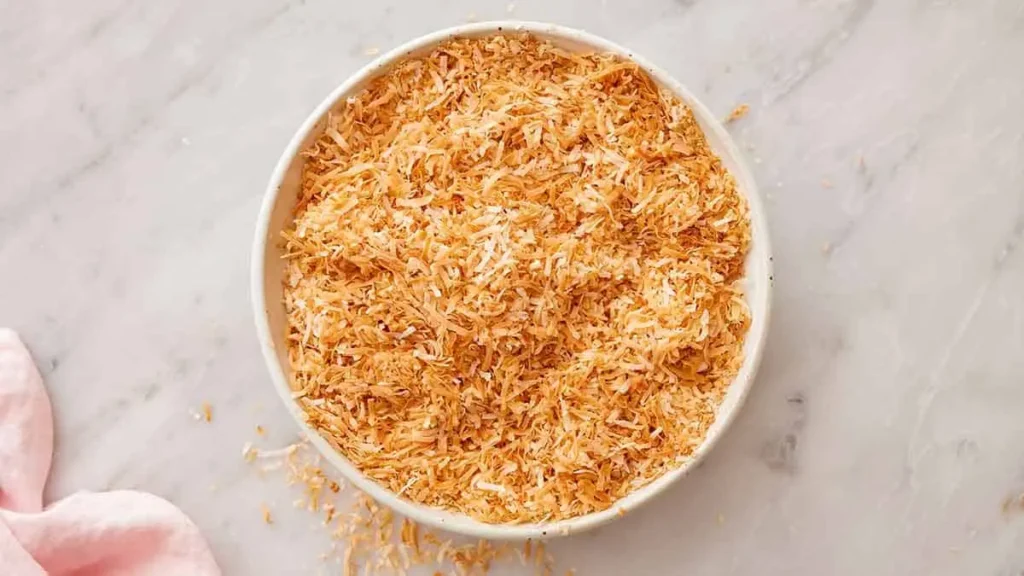
Toasting desiccated coconut transforms it — the heat drives out residual moisture, triggers the Maillard reaction in the coconut's natural sugars, and produces a deeply nutty, caramelized flavor and golden color that raw desiccated coconut cannot match.
Toasted desiccated coconut is worth the extra 5 minutes in almost any application.
Stovetop Method (Faster — Better for Small Quantities)
- Place a dry skillet (no oil) over medium heat.
- Add desiccated coconut in a thin, even layer — do not crowd the pan.
- Stir or shake continuously — desiccated coconut burns quickly once it starts browning.
- Toast for 3-5 minutes until golden brown and aromatic.
- Immediately transfer to a cool plate — it continues cooking in the hot pan if left.
Oven Method (Better for Large Quantities)
- Preheat oven to 160°C (325°F).
- Spread desiccated coconut in a thin, even layer on a parchment-lined baking sheet.
- Bake for 5-8 minutes, stirring every 2 minutes.
- Watch carefully — the edges brown faster than the center.
- Remove when mostly golden — it will continue to toast slightly from residual heat.
| Warning Sign | What To Do |
| Coconut smells burnt before it looks golden | Your heat is too high — reduce by 20% and start over with fresh coconut |
| Uneven browning (edges dark, center pale) | Stir more frequently; use a wider, shallower pan; reduce quantity per batch |
| Coconut clumping together | Break apart before toasting; ensure pan is completely dry — moisture causes clumping |
| Coconut not browning after 8 minutes | Increase heat slightly; ensure pan is properly preheated before adding coconut |
12 Uses for Desiccated Coconut in Cooking: Sweet and Savory
This is the most comprehensive section — covering all major applications from baking to curries to beverages, organized by category for easy reference.
Sweet Applications
- Baked goods (cakes, cookies, muffins): Desiccated coconut adds moisture retention, texture, and natural coconut flavor to batters and doughs. Fine or medium grade blends invisibly into the batter; coarse or flakes create visible texture. Use 50-100g per standard cake recipe. Our coconut sugar cookie recipe pairs coconut sugar with desiccated coconut for maximum coconut flavor.
- Granola and muesli: Medium or long thread grade mixed with oats, nuts, and dried fruit. Toasted desiccated coconut is particularly valuable here — the caramelized flavor elevates the entire blend. Use 20-30% coconut by weight of the dry mix.
- Coconut macaroons: The primary ingredient — desiccated coconut is mixed with egg whites and sugar, then baked. Fine or medium grade creates the classic dense, chewy texture.
- Chocolate confectionery (truffles, bonbons, bounty-style bars): Fine desiccated coconut mixed with condensed milk or coconut cream creates the filling. The coconut acts as both flavor and structure.
- No-bake energy balls and protein balls: Desiccated coconut serves as a binder and flavor carrier when combined with dates, nut butter, or oats. Lightly rehydrated coconut creates a softer texture; dry coconut creates a firmer ball.
- Dessert toppings and coatings: Toasted desiccated coconut or coconut flakes make an excellent topping for cakes, ice cream, panna cotta, and parfaits. The toasted version adds both visual appeal and textural contrast.
Savory Applications
- Curries (Thai, Indian, Sri Lankan, Indonesian): Desiccated coconut — typically rehydrated — is a foundational ingredient in curry pastes and sauces across South and Southeast Asian cuisines. It adds body, natural sweetness, and coconut flavor without the liquid of coconut milk. Toast first for deeper flavor, then rehydrate for texture.
- Coconut chutney and sambol: South Indian coconut chutney and Sri Lankan pol sambol both use grated/desiccated coconut as their base. Rehydrate the desiccated coconut fully before processing with spices, chillies, and aromatics.
- Crusting and coating for proteins: Coarse desiccated coconut or coconut flakes make an excellent coating for chicken, fish, or shrimp — mixed with breadcrumbs or used alone. The natural fat content helps achieve a golden crust in the oven or pan.
- Rice dishes (coconut rice, nasi lemak): Toasted desiccated coconut mixed into cooked rice adds textural interest and flavor. In Indonesian and Malaysian cooking, coconut is integral to several rice preparations.
- Salad toppings and grain bowl additions: Toasted coconut flakes or coarse desiccated coconut add crunch and flavor to salads, Buddha bowls, and grain dishes — a natural complement to tropical fruit, avocado, and lime-based dressings.
- Soups and stews: Finely desiccated coconut can be ground or blended into soups for body and coconut flavor — a lighter alternative to coconut cream for calorie-conscious applications.
| Application Category | Best Grade | Raw or Toasted? | Rehydrate First? |
| Cakes and muffins | Fine or Medium | Raw | No |
| Cookies and biscuits | Fine or Medium | Either | No |
| Granola and snack bars | Medium or Coarse | Toasted | No |
| Macaroons | Fine or Medium | Raw | No |
| Confectionery filling | Fine | Raw | Sometimes (for softer texture) |
| Decorative toppings | Flakes or Coarse | Toasted | No |
| Curries and Asian sauces | Medium | Toasted first | Yes — after toasting |
| Coconut chutney/sambol | Medium or Fine | Raw | Yes — fully |
| Protein coatings | Coarse or Flakes | Raw | No |
| Coconut rice | Fine or Medium | Toasted | No |
| Salad toppings | Flakes or Coarse | Toasted | No |
| Soups for body | Fine | Raw | Yes — partially |
Substitutions and Conversions
When a recipe calls for fresh grated coconut or shredded coconut but you only have desiccated coconut — or vice versa — here are the practical conversion guidelines:
| Recipe Calls For | Use Desiccated Coconut At | Adjustment Needed |
| 1 cup fresh grated coconut | 1 cup desiccated coconut (rehydrated) | Rehydrate with ~½ cup water before using |
| 1 cup sweetened shredded coconut | 1 cup desiccated coconut (unsweetened) + 1-2 tbsp sugar | Adjust sweetness; texture will be slightly drier |
| 1 cup coconut flakes | 1 cup coarse desiccated coconut | Minimal adjustment needed — slightly finer texture |
| 2 tbsp fresh coconut (garnish) | 2 tbsp toasted desiccated coconut | Better visual result; toasted version preferred for garnish |
| Coconut flour (in baking) | NOT interchangeable | Coconut flour and desiccated coconut have very different fiber, fat, and absorbency profiles |
Storage Tips: How to Keep Desiccated Coconut Fresh
- Unopened package: Store in a cool, dry place away from direct sunlight. Shelf life: 12-18 months from production date. Check the 'best before' date on the package.
- Opened package: Transfer to an airtight container immediately. Store in a cool, dry cupboard (not near the stove) or in the refrigerator. Use within 6 months of opening.
- Freezer storage: Desiccated coconut freezes exceptionally well — freeze in airtight zip-lock bags for up to 12 months. No need to thaw before use in baking; it can be added directly to batters from frozen.
- Toasted desiccated coconut: Store in an airtight container at room temperature for up to 2 weeks. The flavor will gradually diminish — toast fresh for best results.
- Rehydrated desiccated coconut: Use immediately or within 24 hours. Store covered in the refrigerator. Do not freeze rehydrated coconut — ice crystals damage the texture.
- Signs of spoilage: Discard if you notice a rancid smell (similar to old cooking oil), visible mold, or clumping due to moisture absorption. Properly stored desiccated coconut should smell fresh, nutty, and mildly sweet.
For Food Manufacturers: Desiccated Coconut as a Food Ingredient

For food manufacturers and product developers, desiccated coconut is one of the most versatile natural ingredients available — contributing texture, flavor, fat, and visual appeal simultaneously with clean-label credentials.
Our article on applications of coconut products in the food industry covers the full range of industrial applications.
For pricing, grade specifications, MOQ, and sourcing information for bulk desiccated coconut from Indonesia, our complete buyer's guide on bulk desiccated coconut from Indonesia: grades, price & where to buy provides everything you need.
At commercial scale, the two most important sourcing criteria for desiccated coconut are food safety certification and organic availability.
Indonesia's certified suppliers — including those holding BRCGS Food Safety Grade A certification — represent the highest standard for food manufacturing supply chains.
For brands requiring organic desiccated coconut with EU Organic or USDA Organic certification, our guide on exporting organic coconut products from Indonesia covers the full documentation chain.
| Source certified desiccated coconut directly from Indonesia Global Coco Sugar supplies BRCGS Food Safety Grade A certified desiccated coconut from Indonesia — fine, medium, coarse, long thread, and flakes — in conventional and organic grades. For food manufacturers, importers, and brand owners sourcing at commercial scale. Contact Our Export Team >>> View Our Desiccated Coconut Range & Prices >>> |