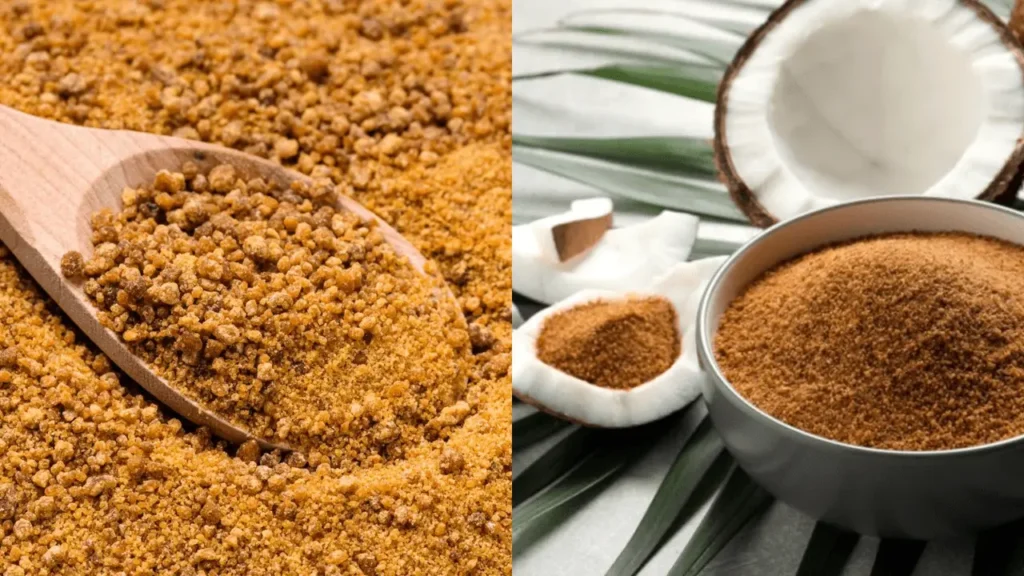
Coconut sugar is commonly available in granulated and powdered forms, but the difference is more important than appearance.
Particle size can affect blending, dissolution, texture, flow, dust generation, dosing, segregation, and processing efficiency.
For a food manufacturer, neither form is universally better.
The right choice depends on the production line, the other ingredients in the formula, the desired texture, and whether the coconut sugar will be dissolved, blended, refined, or used as a visible component in the finished product.
This guide explains how to compare both forms from a manufacturing perspective so R&D and procurement teams can select a specification that fits the process rather than choosing “powder” or “granule” by name alone.
For the complete purchasing parameters behind moisture, mesh, color, documentation, and quality control, see our organic coconut sugar specification guide.
Quick Answer: Granulated vs Powdered Coconut Sugar
The practical difference is mainly particle size and how that particle size interacts with the manufacturing process.
Powdered coconut sugar may be useful where finer distribution or a smaller starting particle size is needed.
Granulated coconut sugar is often practical for general food manufacturing, bakery, granola, toppings, and processes that already include dissolution or further particle-size reduction.
| Factor | Granulated Coconut Sugar | Powdered Coconut Sugar |
| Particle size | Larger particles / granules | Finer particles; exact specification varies by supplier |
| Handling | Generally straightforward for general-purpose ingredient handling | Finer material may require more attention to dust, flow, and powder handling |
| Dry blending | Good for many standard formulations | Can be useful where fine, uniform distribution is important |
| Dissolution | Works when the process provides sufficient time, temperature, and agitation | Finer particles may dissolve or disperse faster under suitable conditions |
| Texture visibility | More noticeable if not dissolved or further processed | Less visually or texturally noticeable in many fine-texture systems |
| Bakery | Strong general fit | Useful for premixes and finer-texture applications |
| Beverages | Suitable with an adequate dissolution step | Useful when finer dispersion is desired |
| Chocolate | Still requires refining to the manufacturer's final fineness target | Lower starting particle size may reduce initial particle-size burden, but final refining is still required |
| Granola / toppings | Strong fit | Often unnecessary unless the formula specifically requires fine powder |
| Instant / dry premix | Depends on formula and mixing system | Often a strong candidate when particle-size compatibility supports uniform blending |
First, Clarify What “Powdered Coconut Sugar” Means

One of the biggest procurement mistakes is assuming that every supplier uses the terms “granulated” and “powdered” in exactly the same way. They do not.
What Is Granulated Coconut Sugar?
Granulated coconut sugar is generally produced by concentrating coconut blossom sap until it crystallizes or forms a dry sugar mass, followed by granulation, drying, screening, or related size-control steps.
The finished material has visible granules rather than a flour-like texture.
For manufacturers, the key point is not the marketing name “granulated.” It is the supplier's actual particle-size range, moisture specification, color, flow behavior, and batch consistency.
Powdered Coconut Sugar May Be Produced in Different Ways
In some commercial supply chains, powdered coconut sugar is produced by milling or grinding a previously granulated sugar into a finer particle size.
In food-science research, coconut sugar powder has also been produced from coconut sap using technologies such as spray drying and vacuum drying.
Those processing routes can produce different physical structures.
A study comparing vacuum-dried and spray-dried coconut sugar reported differences in powder characteristics and described the influence of drying method and drying aids.
That does not mean every commercial powdered coconut sugar contains a carrier or is spray-dried. It means buyers should not assume the production method from the word “powder” alone.
Why Buyers Should Ask the Supplier
When powdered coconut sugar is being evaluated for an industrial formula, ask for the actual specification instead of relying on the product name. Useful questions include:
- How is the powder produced?
- Is it simply milled granulated coconut sugar, or produced through another drying process?
- Does the product contain any carrier, anti-caking agent, or processing aid that must be declared?
- What is the particle-size or mesh specification?
- What is the moisture specification?
- Can the supplier provide a current COA and ingredient declaration?
The Main Difference: Particle Size and Particle Distribution

Granulated and powdered coconut sugar differ most visibly in particle size, but a useful B2B specification goes beyond one mesh number.
A manufacturer also needs to understand how broad or narrow the particle-size distribution is and whether the supplied material stays consistent between lots.
Mesh Number Is Only Part of the Picture
Supplier terminology is not standardized enough to assume that “powder” always equals one mesh size or that “granule” always equals another.
Different commercial suppliers publish different particle-size ranges for products with the same general form name.
That is why the purchasing specification should define the form and the actual particle-size requirement that matters to the manufacturing line.
For GCS-specific current parameters, confirm the latest organic coconut sugar specifications before placing an order.
Why Distribution Matters
Two powders can have the same headline mesh description but behave differently if one has a much wider spread of coarse and very fine particles.
Particle distribution can affect flow, segregation, dust, dissolution, and the consistency of dosing in automated systems.
For processes that are highly sensitive to particle size, procurement and QA teams may need a tighter supplier specification or additional sieve / particle-size verification rather than a broad “powdered” label.
How Particle Size Changes Manufacturing Performance
Blending and Ingredient Distribution
Fine coconut sugar can be useful when the formula contains other fine powders and the manufacturer wants a more uniform dry blend.
This can matter in beverage premixes, protein powders, seasoning-style systems, and other multi-ingredient dry formulations.
Granulated coconut sugar can still blend effectively in many products, especially when the process includes high-shear mixing, wet incorporation, or a later dissolution step.
The best form depends on the other ingredients and the equipment—not on a rule that “powder mixes better.”
Dissolution and Dispersion
Smaller particles provide more surface area relative to their mass, so powdered coconut sugar may dissolve or disperse faster under suitable conditions.
However, actual performance also depends on liquid temperature, agitation, concentration, the surrounding ingredient matrix, and the order of addition.
For beverage manufacturers, this is why bench and pilot trials are more reliable than a universal claim such as “powder dissolves instantly.”
Texture and Mouthfeel
A finer starting material may be useful when the finished product needs a smooth texture or when visible sugar crystals would be undesirable.
In products where granulation is acceptable or where the sugar is fully dissolved or further refined, granulated sugar may perform just as well.
Flowability and Dosing
Finer powders can behave differently inside hoppers, screw feeders, augers, weigh systems, and pneumatic transfer equipment.
Very fine particles may compact, bridge, or flow differently from larger granules depending on moisture, surface properties, equipment design, and handling conditions.
That is another reason why a manufacturer should validate the chosen form on the real production line before locking a long-term purchase specification.
Dust Generation and Housekeeping
Powdered ingredients generally require more attention to airborne fines, dust control, housekeeping, and operator handling than larger granules.
The actual dust level depends on particle-size distribution, moisture, packaging, and transfer method.
If a fine powder provides no formulation advantage, granulated coconut sugar may be operationally simpler for some facilities.
Segregation in Dry Blends
Finer is not automatically better in a dry blend. If coconut sugar particles differ greatly from the size or density of flour, cocoa, protein powder, minerals, fibers, or other ingredients, the blend may segregate during transfer, vibration, transport, or filling.
The objective is particle compatibility and blend stability—not the smallest possible sugar particle.
Granulated vs Powdered Coconut Sugar by Application
| Application | Granulated | Powdered | Main Decision Factor |
| Bakery | Strong general fit | Useful for fine premixes or finer distribution | Texture, mixing method, premix design |
| Beverages | Works when an effective dissolution step is available | Useful when finer dispersion is desired | Temperature, agitation, concentration, sediment risk |
| Chocolate / confectionery | Suitable as a starting material but requires final refining | May reduce starting particle size, but still requires final refining | Final chocolate fineness, rheology, refining process |
| Granola / cereal / snack clusters | Strong fit | Usually less necessary | Visible texture, dry handling |
| Protein / functional powder | Depends on particle compatibility | Often useful if it matches the powder system | Segregation, dust, flow, uniformity |
| Instant drink / dry premix | Possible | Often a strong candidate | Dispersion, dissolution, particle compatibility |
| Toppings / retail sweetener | Often preferred for visible granular texture | Useful only if a fine texture is specifically desired | Appearance and consumer texture expectation |
For a broader overview of where coconut sugar is used across food manufacturing, see our food-industry applications guide.
When Granulated Coconut Sugar Is the Better Choice
Granulated coconut sugar is often the more practical form when the application does not need a very fine starting particle size. It may be the better choice when:
- general bakery or food manufacturing is the primary use
- a visible granular texture is acceptable or desirable
- granola, cereal, toppings, or clusters need a dry crystalline ingredient
- the process already contains a reliable dissolution step
- the product is further milled or refined during manufacturing
- powder fineness would add dust or handling complexity without a clear functional benefit
Granulated does not mean lower quality. It simply provides a different particle format that may fit the factory and finished product better.
When Powdered Coconut Sugar Is the Better Choice
Powdered coconut sugar may be the better starting form when the manufacturer benefits from smaller particles or more uniform distribution in a fine powder system. Typical reasons include:
- the formula is an instant drink, powdered beverage, or fine dry premix
- the finished product needs a smoother texture and visible granules are undesirable
- the other dry ingredients are also relatively fine and particle-size compatibility supports uniform blending
- the manufacturer wants a smaller starting particle size before further processing
- the application requires fine distribution but does not justify an in-house milling step
Powdered coconut sugar should still be evaluated for dust, flow, segregation, packaging, and storage behavior. A finer product is not automatically easier to manufacture with.
Finer Does Not Automatically Mean Better
Particle size is a functional specification, not a quality ranking.
Powdered coconut sugar is not automatically a premium version of granulated coconut sugar, and granulated coconut sugar is not automatically inferior.
A fine powder can improve performance in one process and create unnecessary dust, flow, or segregation problems in another.
Likewise, a granule can be ideal for a bakery, topping, or dissolution process but unsuitable where a very fine premix is required.
The better form is the one that produces the required manufacturing behavior and finished-product quality with the least unnecessary process complexity.
How to Choose the Right Form for Your Production Line
Before choosing a supplier specification, R&D and production teams should answer a few process questions:
- Is the final product a wet system, dry blend, or fat-based system?
- Does the coconut sugar need to dissolve completely?
- Is visible granulation acceptable in the finished product?
- How fine are the other dry ingredients in the blend?
- Will the sugar be further milled or refined during processing?
- Does the factory use hoppers, screw feeders, augers, or pneumatic transfer?
- How important are dust control and housekeeping in the ingredient-handling area?
- Is segregation during blending, transport, or filling a concern?
- What finished texture or mouthfeel does the product require?
- Can the supplier maintain the required particle-size range from lot to lot?
| Production Need | Likely Starting Choice | Reason to Validate |
| General-purpose bakery / dry ingredient use | Granulated | Confirm mixing, texture, and moisture performance |
| Fine instant premix | Powdered | Confirm segregation, dust, dispersion, and flow |
| Beverage with dedicated hot dissolution step | Either may work | Compare dissolution time and process efficiency |
| Cold beverage / limited mixing | Powdered may be useful | Validate real-formula dissolution and sediment |
| Chocolate that will be refined | Either may work | Final chocolate fineness matters more than incoming form alone |
| Granola / visible topping | Granulated | Check texture and adhesion in the finished product |
| Automated fine-powder dosing system | Powdered may fit | Check hopper behavior, compacting, and dust control |
Run a Production Trial Before Locking the Specification
A supplier sample is most useful when it is tested through the same process that will be used commercially.
The trial should compare how each technically feasible form behaves from ingredient handling through the finished product.
| Trial Step | What to Check |
| 1. Request representative samples | Obtain granulated, powdered, or both forms with the current supplier specification and batch information. |
| 2. Record the incoming form and particle specification | Document mesh or particle-size range, moisture, color, and any other agreed parameters. |
| 3. Run a bench or pilot batch | Use the actual formula and process sequence rather than testing coconut sugar in isolation. |
| 4. Observe dosing and mixing | Check whether the material flows, feeds, disperses, or blends consistently in the available equipment. |
| 5. Measure dissolution or dispersion if relevant | For wet systems, compare how each form incorporates under the real temperature, concentration, and agitation conditions. |
| 6. Evaluate finished texture and sensory quality | Check mouthfeel, visible particles, sweetness, color, flavor, and any relevant stability issue. |
| 7. Review housekeeping and process efficiency | Note dust, residue, transfer loss, additional milling, mixing time, and any operational burden. |
| 8. Repeat with a second lot | Confirm that the preferred form performs consistently across more than one batch. |
| 9. Lock the purchasing specification | Define the product form and the measurable parameters that matter to the approved process. |
What Buyers Should Put in the Purchase Specification
After R&D approves the preferred form, procurement should convert that result into a measurable purchasing specification.
The exact list depends on the application, but common checks include:
- exact product form: granulated or powdered
- particle-size or mesh requirement
- acceptable particle-size distribution if the process is sensitive to fines or coarse particles
- moisture specification
- color range
- taste and aroma profile
- ingredient composition
- carrier, anti-caking agent, or processing-aid declaration where relevant
- microbiological requirements
- bulk packaging and moisture-protection requirements
- COA requirements and lot identification
- batch-to-batch consistency expectations
For the complete buyer checklist, use our organic coconut sugar specifications guide. For batch documentation, see the coconut sugar COA guide.
Request the Actual Specification, Not Just “Powder” or “Granule”
Two suppliers can both use the word “powder” while supplying materially different particle sizes, production methods, compositions, or moisture levels. The same is true for “granulated.”
For procurement teams, the safest approach is to request the current technical specification and ask the supplier to confirm the parameters that affect the manufacturing process.
At minimum, clarify:
- product form and processing method
- particle-size or mesh specification
- composition and declaration of any carrier or additive
- moisture
- COA availability
- packaging
- sample availability
- lot-to-lot consistency controls
This helps avoid a common sourcing problem: approving a generic product name rather than approving the actual ingredient behavior required by the factory.
Source Granulated or Powdered Organic Coconut Sugar from Indonesia
Global Coco Sugar supplies organic coconut sugar for B2B buyers in multiple product forms.
For a manufacturing inquiry, it is more useful to share the application and process requirements than to request “powder” or “granule” without context.
Review our organic coconut sugar product page for current product information, or contact the Global Coco Sugar export team to discuss the latest specification, sample requirements, packaging options, COA, certification documents, and quotation details.
For the fastest technical evaluation, include your application, preferred form, target particle size if already defined, packaging requirement, destination market, and any QA parameters that must be met.
Conclusion
Granulated and powdered coconut sugar can both work well in food manufacturing, but they solve different process needs.
Granulated sugar is often practical for general food production, bakery, granola, toppings, and processes that already dissolve or further reduce particle size.
Powdered sugar can be useful when finer distribution, smaller starting particles, or compatibility with fine dry blends matters.
The decision should not be based on the idea that finer automatically means better.
Manufacturers should compare particle size, handling, dissolution, texture, equipment behavior, and finished-product performance, then validate the preferred form in a bench or pilot trial.
For procurement, the final step is equally important: purchase the measurable specification that R&D approved—not just the words “powdered coconut sugar” or “granulated coconut sugar.”
Frequently Asked Questions
What is the difference between granulated and powdered coconut sugar?
The main difference is particle size. Granulated coconut sugar has larger particles, while powdered coconut sugar is finer, which can affect dissolution, blending, texture, dust generation, flow, and processing performance.
Is powdered coconut sugar just ground granulated coconut sugar?
Sometimes. Powdered coconut sugar can be produced by milling granulated sugar, but other production methods may also be used. Buyers should confirm the supplier's manufacturing process and product specification before purchasing.
Does powdered coconut sugar dissolve faster?
Generally, finer particles can dissolve or disperse faster because they have greater surface area. However, actual performance also depends on temperature, agitation, concentration, and the overall formulation.
Which coconut sugar form is better for beverages?
Both can work depending on the production process. Granulated coconut sugar is suitable when an effective dissolution step is available, while powdered coconut sugar may be preferable for instant or dry beverage applications requiring finer dispersion.
Which coconut sugar form is better for chocolate?
Powdered coconut sugar may provide a finer starting particle size, but chocolate still requires refining to reach the desired finished texture. The best option depends on the manufacturer's refining process, formulation, and rheology requirements.
Which coconut sugar form is better for baking?
Granulated coconut sugar is suitable for many general bakery applications. Powdered coconut sugar can be useful in fine premixes or formulations where more uniform particle distribution is required.
Is powdered coconut sugar higher quality than granulated coconut sugar?
No. Particle size is a functional specification rather than a measure of quality. The better option depends on the application, processing requirements, consistency, food-safety standards, and agreed product specifications.
What mesh size should food manufacturers request?
There is no universal mesh size for coconut sugar. The appropriate particle-size specification depends on the product, processing equipment, dissolution or mixing requirements, and desired finished texture.
Should buyers request samples of both forms?
Yes, especially when both forms are technically suitable. Testing granulated and powdered coconut sugar in the actual production process helps manufacturers compare dissolution, handling, blending, texture, dust, and overall process efficiency before bulk purchasing.