| Direct Answer: What Is the Difference Between Organic and Conventional Coconut Sugar? Organic and conventional coconut sugar are made from the same raw material — coconut palm flower sap — using the same basic process. The difference lies entirely in how the coconut palms are farmed. Organic coconut sugar is produced from coconut palms grown without synthetic pesticides, synthetic fertilizers, or prohibited substances, verified through annual audits by a USDA-accredited or EU-accredited certifying agent. Conventional coconut sugar may or may not use synthetic inputs depending on the specific producer — many Indonesian smallholder producers use minimal inputs naturally, but without third-party organic certification. The practical differences for buyers: organic coconut sugar commands a 25-40% price premium, requires additional per-shipment documentation (Organic Transaction Certificate), and supports 'USDA Organic' or 'EU Organic' label claims that conventional cannot. Nutritionally, the two are essentially identical — the same glycemic index, the same flavor profile, the same production process after harvest. |
When evaluating organic vs conventional coconut sugar, the choice is one of the most consequential sourcing decisions for food brands, retailers, and importers — not because the products differ dramatically, but because the certification infrastructure, documentation requirements, price implications, and label claim opportunities are completely different.
This article explains every meaningful difference between organic and conventional coconut sugar — from farming practices to documentation to pricing — to help you make an informed sourcing decision.
At Global Coco Sugar, we supply both certified organic and conventional coconut sugar from Indonesia, which gives us a firsthand perspective on what the differences actually are — not just what they should be in theory.
Understanding how coconut sugar is produced from coconut palm flower sap provides the foundation for understanding where organic and conventional diverge.
Master Comparison: Organic vs Conventional Coconut Sugar — 12 Parameters
| Parameter | Organic Coconut Sugar | Conventional Coconut Sugar |
| Farming inputs | No synthetic pesticides, synthetic fertilizers, or prohibited substances — verified by annual audit | May use synthetic inputs — varies by producer; many Indonesian smallholders use minimal inputs naturally |
| Third-party verification | Required — USDA-accredited or EU-accredited certifying agent conducts annual farm + facility audit | Not required — no mandatory third-party verification of farming practices |
| Certification | USDA NOP, EU Organic, JAS Organic — publicly verifiable in official databases | BRCGS Food Safety — covers food safety practices, not farming inputs |
| Per-shipment documentation | Organic Transaction Certificate (TC) required per lot — links specific lot to organic certificate | Standard COA from ISO 17025 lab — no TC required |
| Pesticide residue | Tested per certification standard — must comply with NOP or EU MRL limits | Not required to test for pesticides — some buyers specify independently |
| Price premium | 25-40% above conventional (USD 0.60-1.20/kg premium at FCL volumes) | Baseline price — no organic premium |
| MOQ | 1 MT (same as conventional) | 1 MT |
| Label claims supported | 'USDA Organic', 'EU Organic', 'certified organic', 'organic ingredient' | 'Natural', 'refined sugar-free', 'coconut sugar' — but NOT 'organic' |
| Flavor and taste | Virtually identical to conventional — same production process after harvest | Virtually identical to organic — flavor determined by production process, not farming inputs |
| GI and nutrition | GI ~35, same nutritional profile as conventional | GI ~35, same nutritional profile as organic |
| Supply availability | More limited — smaller certified supply base; confirm availability before committing | Larger supply base — wider selection of suppliers and grades |
| Lead time | May require longer lead time for certified lots — plan 2-3 weeks extra for TC issuance | Standard lead time — no TC documentation delay |
Farming Practices: The Core Difference
The fundamental distinction between organic and conventional coconut sugar lies in what happens on the coconut farm — not in the processing facility, not in the packaging, and not in the final product's composition.
Organic Coconut Farming
- No synthetic pesticides: Certified organic coconut farms may not use any pesticide not on the NOP (or EU Organic) National List of Allowed and Prohibited Substances. Pest management relies on biological controls, physical barriers, and approved natural substances.
- No synthetic fertilizers: Soil fertility maintained through compost, green manure, crop rotation, and approved organic inputs — not synthetic NPK fertilizers.
- 3-year conversion period: A coconut farm cannot be immediately certified organic — it must be managed without prohibited substances for a minimum of 3 years before the first certified crop. During this conversion period, the farmer bears the cost of organic practices without the organic price premium.
- Annual audit requirement: A USDA-accredited (or EU-accredited) inspector visits the farm annually to verify that organic practices are being maintained. Non-compliances can result in certificate suspension.
- Traceability to farm level: Certified organic coconut sugar is traceable to the specific farms or farmer cooperatives that supplied the sap — allowing buyers to verify the origin chain.
Conventional Coconut Farming
- Flexible input use: Conventional farmers may use any approved agricultural input including synthetic pesticides and fertilizers. However, many Indonesian smallholder coconut sugar producers use minimal inputs naturally — partly due to the low-input traditional farming practices and partly due to economic constraints on purchasing synthetic inputs.
- No mandatory third-party verification: Conventional coconut farms are not required to undergo annual audits of their farming practices for commercial coconut sugar production.
- Important context: Many Indonesian conventional coconut sugar producers actually farm with practices very similar to organic — minimal external inputs, traditional methods, no heavy pesticide use. The key difference is that these practices are not verified, documented, or certified by a third party.
| The 'de facto organic' reality of many Indonesian coconut farms A significant portion of Indonesian coconut sugar — particularly from Central Java smallholder cooperatives — is produced from coconut palms that have never received synthetic pesticides or fertilizers, simply because the traditional farming practices do not use them and the economics do not justify the input cost. These farms are 'de facto organic' in their practices but 'conventional' in their certification status. This is why many buyers who inspect Indonesian coconut sugar farms are surprised to find that conventional farms often look more 'organic' than they expected. The distinction is certification and verification — not necessarily current practice. |
Certification and Verification: The Documentation Difference

This is where the practical difference between organic and conventional is most visible for buyers.
Our guide on what certifications a coconut sugar supplier should have covers the full certification landscape.
Note that BRCGS Food Safety certification — which both organic and conventional suppliers can hold — covers food safety management, not farming practices.
A supplier can hold BRCGS Grade A without any organic certification, and vice versa.
| Certification Type | Organic Coconut Sugar | Conventional Coconut Sugar |
| USDA NOP | ✅ Required for 'USDA Organic' US market claims | ❌ Not applicable — cannot claim USDA Organic |
| EU Organic | ✅ Required for EU Organic label claims | ❌ Not applicable — cannot claim EU Organic |
| JAS Organic | ✅ Required for Japanese Organic claims | ❌ Not applicable |
| BRCGS Grade A | ✅ Can hold (food safety, not farming) | ✅ Can hold (food safety, not farming) |
| HACCP | ✅ Can hold | ✅ Can hold |
| Halal MUI | ✅ Can hold | ✅ Can hold |
| Kosher | ✅ Can hold | ✅ Can hold |
Documentation Requirements: What Buyers Receive Per Shipment
The documentation difference per shipment is significant — and this is where many first-time organic buyers get caught off-guard.
Our dedicated article on the USDA organic certification process for Indonesian coconut sugar explains the full certification chain.
Our article on exporting organic coconut sugar from Indonesia covers the per-shipment documentation in detail.
| Document | Organic Shipment | Conventional Shipment |
| Commercial invoice | ✅ Required | ✅ Required |
| Packing list | ✅ Required | ✅ Required |
| Bill of lading | ✅ Required | ✅ Required |
| Phytosanitary certificate | ✅ Required | ✅ Required |
| Certificate of Analysis (ISO 17025 lab) | ✅ Required per lot | ✅ Required per lot |
| Supplier's Organic Certificate copy | ✅ Required — per shipment | ❌ Not applicable |
| Organic Transaction Certificate (TC) | ✅ Required per production lot — before loading | ❌ Not applicable |
| Pesticide residue test results | ✅ Required as part of organic certification | Optional — some buyers specify independently |
| USDA NOP certificate verification | ✅ Buyer must verify at ams.usda.gov/integrity | ❌ Not applicable |
| The TC must arrive BEFORE the container leaves Indonesia The most common organic compliance mistake: buyers accept a supplier's promise that the Transaction Certificate will follow after the container departs. This is not acceptable. The TC must be issued by the certifying agent and provided to the buyer before container loading. If the TC lot number does not match the COA and packing list exactly, the organic status of that shipment cannot be verified — do not declare it as organic in your finished product. |
Does Organic Coconut Sugar Taste Different from Conventional?

This is one of the most frequently asked questions — and the honest answer is: not meaningfully.
The glycemic index of coconut sugar is approximately 35 for both organic and conventional, and the nutritional profiles are essentially identical.
Here is why: the flavor and nutritional characteristics of coconut sugar are determined by the production process — the degree of evaporation, the temperature, the processing method — not by whether the farm used synthetic inputs or not.
| Attribute | Organic | Conventional | Difference? |
| Glycemic Index | ~35 | ~35 | None — same raw material, same process |
| Caramel flavor | Rich caramel-butterscotch | Rich caramel-butterscotch | None — flavor is from Maillard reaction during processing |
| Mineral content | Same trace minerals (K, Mg, Fe) | Same trace minerals | None — minerals from soil, not certification status |
| Inulin fiber | ~1-3% of carbohydrates | ~1-3% of carbohydrates | None |
| Color | Golden brown to dark brown | Golden brown to dark brown | None from certification — processing determines color |
| Aroma | Caramel, coconut notes | Caramel, coconut notes | None from certification |
| Pesticide residue | Must comply with NOP/EU MRL limits | Not systematically tested | Potentially different — organic verified, conventional not |
The one area where there may be a difference is pesticide residue — though as noted above, many conventional Indonesian coconut sugar farms use minimal inputs.
The point is that organic certification provides verified documentation of pesticide-free status; conventional does not.
For buyers making label claims that depend on verified organic status, this documentation difference is the critical one — not the sensory or nutritional difference.
Price Difference: Is the Organic Premium Justified?
For a full breakdown of current FOB pricing for both organic and conventional coconut sugar from Indonesia, see our coconut sugar export price from Indonesia guide.
| Price Tier | Conventional FOB/kg | Organic FOB/kg | Premium | Organic Premium Source |
| Standard grade (FCL) | USD 1.80-2.40 | USD 2.40-3.20 | +25-40% | Farm conversion cost + certification fees + smaller supply base |
| Premium/fine grade (FCL) | USD 2.00-2.80 | USD 2.80-3.60 | +25-40% | Same factors — grade premium compounds with organic premium |
| LCL (< 1 MT) | +15-30% above FCL | Similar premium above organic FCL | Similar | Freight premium for small volume |
| Annual contract (3+ FCL) | Best FCL pricing | Best organic FCL pricing | Narrowing | Volume discounts available for both tiers |
| When the organic premium is commercially justified The organic premium pays back when your finished product can capture a retail premium greater than the ingredient cost increase. For organic-certified consumer products in EU and US natural retail, the retail premium for an organic claim is typically 30-60% above the non-organic equivalent — easily covering a 25-40% ingredient cost premium at typical inclusion rates. For commodity applications where coconut sugar is a minor ingredient and organic claims are not on the product label, conventional coconut sugar with BRCGS certification may be the more commercially rational choice. |
Decision Matrix: Should You Source Organic or Conventional?
| Your Situation | Recommended Choice | Reason |
| You are making a finished product with 'USDA Organic' or 'EU Organic' label claim | Organic — mandatory | The organic label claim legally requires certified organic ingredients — no alternative |
| You are a food manufacturer and coconut sugar is a minor ingredient with no organic claim | Conventional | No label benefit from organic — save the premium |
| You supply Whole Foods, Aldi, or EU major retail that requires organic vendor compliance | Organic | Retail vendor requirement may specify organic ingredients regardless of label claim |
| You are developing a premium 'clean label' product without a specific organic claim | Conventional (BRCGS) | BRCGS-certified conventional supports clean label, natural, and refined sugar-free claims |
| You supply health food retail with educated consumers who value organic | Organic | Consumer perception premium supports ingredient cost premium — justifiable investment |
| You are a trader or distributor who doesn't know your end customer yet | Both — dual inventory | Maintain both tiers to serve different customer requirements without lead time gaps |
| You are testing a new product and want to validate market before committing to organic | Conventional first | Lower ingredient cost for initial R&D and market testing; switch to organic at scale |
Shelf Life and Storage: Are There Practical Differences?
From a shelf life and storage perspective, organic and conventional coconut sugar are essentially identical — both follow the same specifications when properly produced and packaged:
| Parameter | Organic | Conventional | Notes |
| Shelf life (sealed, cool & dry) | 18-24 months | 18-24 months | Identical — determined by moisture content and packaging, not organic status |
| Moisture content | Max 3% | Max 3% | Same specification — critical for shelf stability |
| Water activity | ~0.45-0.55 | ~0.45-0.55 | Identical — shelf stable for microbial growth |
| Storage temperature | Below 25°C, dry | Below 25°C, dry | Same conditions recommended |
| Post-opening | 6-12 months airtight | 6-12 months airtight | Identical |
| Caking tendency | Moderate | Moderate | Both can cake at humidity > 60% — store in airtight conditions |
How to Find and Verify a Certified Organic Coconut Sugar Supplier
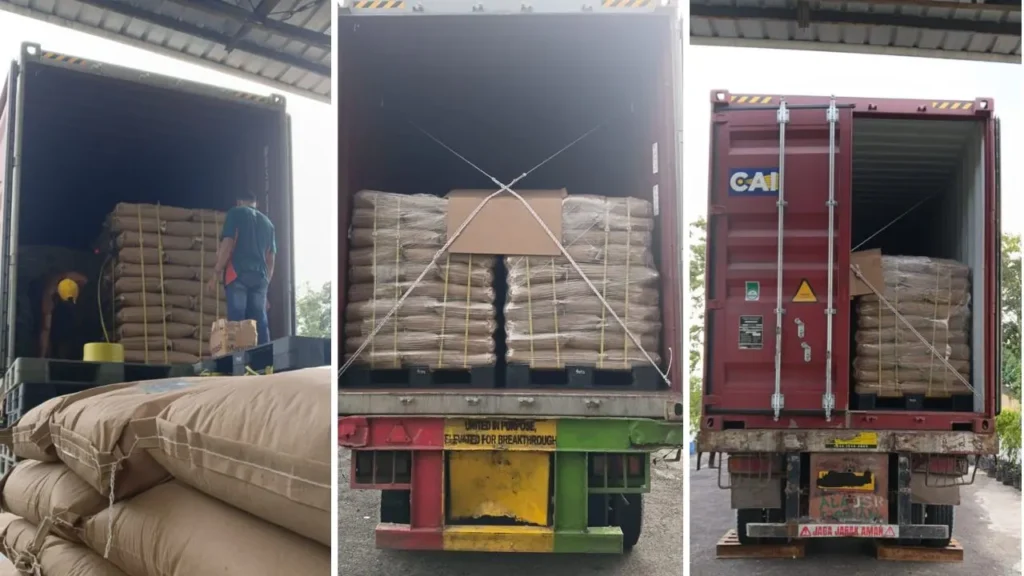
Our article on why buyers choose certified organic coconut sugar from Indonesia covers the full commercial case for organic sourcing.
For a practical guide to finding and evaluating Indonesian certified suppliers, see our bulk coconut sugar supplier Indonesia guide.
Organic-specific verification steps beyond standard supplier qualification:
- Verify NOP certificate at ams.usda.gov/integrity: Search by supplier name — confirm Active status, coconut sugar in scope, expiry date beyond delivery.
- For EU organic: check OFIS database at ec.europa.eu: EU Organic and USDA NOP are separate certifications — confirm the specific certification relevant to your market.
- Confirm TC process: Ask: 'Will you issue a Transaction Certificate for each lot before container loading?' Confirm which certifying body issues it.
- Request sample TC: Ask for a TC from a previous shipment to verify the format and the lot number matching process.
- Verify certifying body accreditation: Confirm the certifying agent is USDA-accredited (for USDA NOP) or EU-accredited — not all certifiers are valid for all markets.
| Source certified organic or conventional coconut sugar from a single verified supplier Global Coco Sugar supplies both USDA NOP certified organic and BRCGS-certified conventional coconut sugar from Central Java, Indonesia. Both tiers with full COA from ISO 17025-accredited laboratories. Organic shipments include Transaction Certificates per lot before container loading. Certifications publicly verifiable. Contact Our Organic Certification Team >>> View Our Certified Coconut Sugar Range >>> |
Conclusion: Two Tiers of the Same Product — Choose Based on Your Label, Not Your Preference
The difference between organic and conventional coconut sugar is a certification and documentation difference — not a meaningful nutritional, sensory, or quality difference.
Both are minimally processed, natural sweeteners with a low glycemic index, made from the same raw material through the same process.
The decision between them should be driven entirely by your label claim requirements and the commercial value those claims deliver in your target market.
If you need 'USDA Organic' or 'EU Organic' on your label — source organic, with full Transaction Certificate documentation per lot.
If you need 'natural', 'refined sugar-free', or 'clean label' positioning — BRCGS-certified conventional delivers the same commercial result at a lower ingredient cost.
If you are unsure, source conventional for R&D and market testing, then switch to organic when you have validated the retail premium.
| Both organic and conventional certified coconut sugar — from one Indonesian supplier Global Coco Sugar supplies USDA NOP and EU Organic certified coconut sugar alongside BRCGS Grade A certified conventional coconut sugar from Central Java, Indonesia. Full COA per lot from ISO 17025-accredited laboratories. Transaction Certificates issued per lot before container loading for all organic shipments. Contact Our Team >>> View Our Certified Coconut Sugar Range >>> Our Certifications & Company Profile >>> |
Frequently Asked Questions
What is the difference between organic and conventional coconut sugar?
Organic coconut sugar is produced according to certified organic standards and is verified by an accredited certification body. Conventional coconut sugar does not require organic certification. While both products are similar in taste, nutrition, and functionality, only organic coconut sugar can support certified organic label claims.
Is organic coconut sugar healthier than conventional?
Nutritionally, organic and conventional coconut sugar are very similar. The primary difference is that organic coconut sugar is produced under certified standards that restrict the use of synthetic agricultural inputs and provide third-party verification of compliance.
Does organic coconut sugar taste different from conventional?
No. Organic and conventional coconut sugar generally have the same caramel-like flavor and appearance. Taste differences are more likely to result from production methods and raw material quality than from organic certification status.
Is organic coconut sugar worth the premium for food manufacturers?
It depends on the product positioning and target market. Organic coconut sugar is essential for products carrying certified organic claims, while conventional coconut sugar may offer a more cost-effective option for products focused on natural or clean-label positioning.
Can conventional coconut sugar be labeled as "natural" or "clean label"?
In many markets, conventional coconut sugar can support natural and clean-label positioning without requiring organic certification. However, manufacturers should always verify labeling requirements and regulations in their target market.