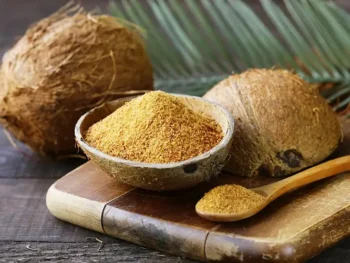
Coconut nectar syrup is one of the most versatile natural sweeteners available from Indonesia — a thick, dark amber liquid derived from the sap of coconut palm flower blossoms, with a rich caramel flavor profile, low glycemic index, and clean-label credentials that make it increasingly valuable for food manufacturers, beverage brands, and health food importers worldwide.
This article covers everything buyers need to know about sourcing organic coconut nectar syrup from Indonesia in bulk — from technical specifications, certifications, MOQ, and the ordering process.
You can browse our organic coconut nectar syrup product range before reading further.
For context on how the raw material — coconut palm flower sap — is transformed into finished nectar, our article on how coconut sugar is produced in Indonesia explains the full production process, which is closely related to coconut nectar production.
Quick Reference: Coconut Nectar Syrup Specifications
For buyers who need technical specifications immediately:
| Parameter | Specification | Notes |
| Product form | Viscous liquid syrup | Dark amber to dark brown color |
| Brix (sugar content) | 70 – 75 Brix | Consistent across batches — verified per COA |
| pH | 4.5 – 5.5 | Mildly acidic — stable for most food applications |
| Moisture content | Max 25% | Lower moisture = higher Brix = more concentrated sweetness |
| Color | Dark amber to dark brown | Natural — no artificial coloring added |
| Flavor profile | Caramel, butterscotch, mild earthiness | Distinctive — evaluate with your base before formulation |
| Glycemic Index | ~35 (low GI) | Similar to granulated coconut sugar |
| Shelf life | 18 – 24 months (sealed, cool & dry) | Store below 25°C, away from direct sunlight |
| Packaging | 25 kg drums, 20 kg jerricans, custom | Food-grade packaging only |
| MOQ | 500 kg | Lower MOQ than granulated coconut sugar (1 MT) |
| Certifications | USDA Organic, EU Organic, BRCGS, Halal | All independently verifiable — see section below |
What Is Organic Coconut Nectar Syrup?
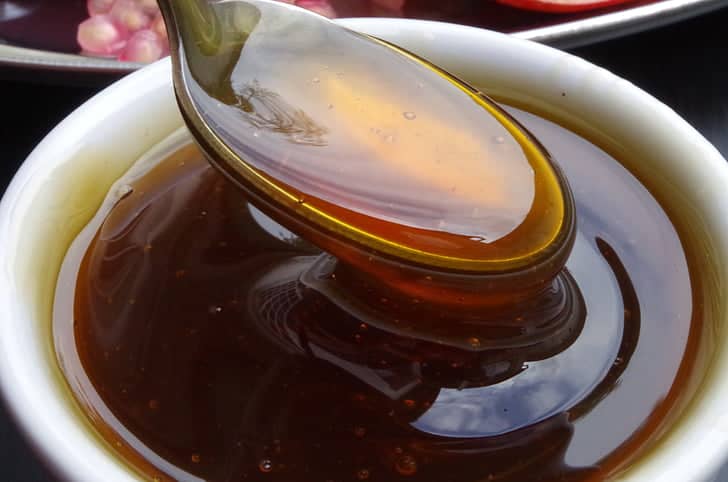
Organic coconut nectar syrup is a natural liquid sweetener made from the sap collected from the flower buds of the coconut palm (Cocos nucifera).
The tapping process involves making careful incisions in the flower blossom stalks, from which the sap flows naturally and is collected daily.
The fresh sap is then gently heated to evaporate excess moisture, concentrating it into a thick, syrupy liquid — without chemical processing, bleaching, or artificial additives.
The result is a minimally processed sweetener that retains the natural minerals, amino acids, and inulin fiber present in fresh coconut sap — giving it a nutritional profile significantly richer than refined cane sugar or corn syrup, and a flavor profile that no industrial sweetener can replicate.
Coconut Nectar vs Coconut Sugar: The Key Difference

Coconut nectar syrup and granulated coconut sugar both originate from the same raw material — coconut palm flower sap. The difference lies in processing: for coconut sugar, the sap is heated until it crystallizes into granules.
For coconut nectar, the evaporation process is stopped at the syrup stage, preserving the liquid form. Both share a similar low glycemic index of approximately 35 — significantly lower than refined white sugar (GI 60-65) — due to the inulin fiber content naturally present in coconut sap.
For a detailed side-by-side comparison of coconut nectar syrup against honey, maple syrup, agave nectar, and other common natural sweeteners — including GI, caloric content, and mineral profile — see our dedicated article on coconut nectar syrup vs other sweeteners.
The Flavor Profile: What Makes Coconut Nectar Unique for Food Formulation
The caramel-like flavor of coconut nectar is not artificial — it develops naturally during the gentle evaporation process.
When the sugars in the coconut sap (primarily fructose and glucose) are heated, they undergo a mild Maillard reaction — a non-enzymatic browning process that creates the characteristic warm, complex flavor notes: caramel, butterscotch, and a subtle earthiness.
This flavor complexity is precisely what makes coconut nectar valuable as a food ingredient beyond its sweetening function.
Unlike neutral sweeteners such as refined sugar or agave, coconut nectar actively contributes to the flavor profile of the finished product — adding depth without overpowering other ingredients.
| Important note for food formulators: evaluate flavor interaction before scale-up The distinctive caramel notes of coconut nectar make it an excellent match for baked goods, confectionery, coffee beverages, sauces, and dark chocolate applications — but require evaluation in lighter-flavored products (clear beverages, white confectionery, neutral dairy) where the flavor addition may be visible or unwanted. Always request a sample and evaluate in your specific formulation before committing to a bulk order. |
Coconut Nectar Syrup Applications in Food Manufacturing

Coconut nectar syrup's combination of liquid format, low GI, and distinctive flavor makes it particularly well-suited for applications where granulated coconut sugar would require dissolution.
For a comprehensive breakdown of food industry applications for coconut-derived sweeteners — including dosage guidance and technical suitability per product category — see our article on applications of coconut sugar and coconut nectar in the food industry.
| Application | Why Coconut Nectar Works Well | Formulation Notes |
| Coffee syrups & beverages | Liquid format dissolves instantly — no heating required. Caramel note complements coffee naturally. | Typical dosage: 10-20g per 250ml serving. Evaluate with your coffee base — dark roast pairs best. |
| Premium sauces & marinades | Savory-sweet balance adds umami depth. No dissolution step needed in sauce production. | Can replace honey or brown sugar 1:1 by weight. Slightly more caramel note than honey. |
| Health bars & snack coatings | Liquid binder with natural sweetening. Contributes to chewy texture in no-bake applications. | Blend with nut butters or oats — acts as natural binder at 15-30% of dry ingredient weight. |
| Bakery glazes & toppings | Natural glaze without artificial shine agents. Caramel notes enhance baked aroma. | Dilute 1:1 with water for thin glaze. Use at full concentration for thick caramel-like drizzle. |
| Plant-based beverages | Rounds out the 'green' or 'beany' flavors common in plant milks and protein beverages. | Start at 1-2% of total liquid weight and adjust to taste. Pairs well with oat and almond bases. |
| Fermented beverages (kombucha) | Low-GI sweetener for secondary fermentation. Distinctive flavor survives fermentation well. | Monitor Brix carefully — start at Brix 70-75 nectar and dilute to target fermentation sugar level. |
| Confectionery & chocolate | Natural caramel note pairs with dark and milk chocolate. Color integration excellent. | Suitable for ganaches, truffles, and soft confectionery. Avoid in white chocolate — color visible. |
For food manufacturers evaluating whether to switch from cane sugar or corn syrup to coconut nectar as a liquid sweetener, our technical article on coconut sugar vs cane sugar for food manufacturing provides relevant context on the Maillard reaction behavior, hygroscopicity, and flavor interaction that also applies to the liquid nectar form.
Certifications for Organic Coconut Nectar Syrup
Buyers making organic label claims on products containing coconut nectar must verify that their supplier holds current organic certification — and that each shipment is accompanied by an Organic Transaction Certificate (TC) per production lot.
Our article on what certifications a coconut products supplier should have explains how to independently verify each certification.
For the specifics of organic documentation requirements per shipment, see our guide on exporting organic coconut products from Indonesia.
| Certification | Coverage | Verifiable At |
| BRCGS Food Safety Grade A | Food safety management system — required by EU and US major retail buyers | brcdirectory.com (public search) |
| USDA Organic (NOP) | US market organic label claims — requires TC per shipment | ams.usda.gov/organic (public search) |
| EU Organic | EU market organic label claims — requires TC per shipment | OFIS database ec.europa.eu (public search) |
| Halal MUI | Compliance with Islamic dietary law — required for Middle East markets | halalmui.org (public search) |
| HACCP | Baseline food safety prerequisite — all markets | Supplier document — request copy |
| Kosher | Jewish dietary law compliance — US/EU specialty retail | Certifying body registry |
Global Coco Sugar holds all certifications listed above for our coconut nectar syrup.
Our certifications and company profile page provides full documentation details including certifying body names, certificate numbers, and validity periods — all independently verifiable.
Coconut Nectar Syrup MOQ, Packaging, and Quotation Factors
Coconut nectar syrup pricing can vary depending on product grade, certification requirements, Brix level, packaging format, order volume, destination country, Incoterms, and current supply conditions.
Because these factors can change from one buyer requirement to another, Global Coco Sugar does not use fixed public pricing as a final reference for bulk coconut nectar syrup orders.
For accurate pricing, buyers are encouraged to request a formal quotation based on their required product type, volume, packaging preference, certification scope, and delivery terms.
| Grade | MOQ Reference | Packaging Options | What Buyers Should Confirm |
|---|---|---|---|
| Conventional coconut nectar syrup | 500 kg | 25 kg drum or 20 kg jerrican | Brix, pH, color, flavor profile, shelf life, and COA availability |
| Organic coconut nectar syrup | 500 kg | 25 kg drum or 20 kg jerrican | USDA/EU Organic scope, certification documents, product specification, and lead time |
| Private label coconut nectar syrup | Based on project requirement | 250 ml / 500 ml glass or PET bottle | Label design, bottle type, cap, carton, MOQ, and destination market requirements |
| Full container 20ft FCL | Around 14–15 MT | Mixed drums may be possible for multi-SKU orders | Production schedule, packaging mix, loading plan, and export documents |
| Trial order note Coconut nectar syrup can be packed in drums or jerricans, making smaller trial volumes practical for formulation testing, sample evaluation, and initial market validation. Final MOQ and shipment arrangement should be confirmed with the sales team based on product type, availability, destination country, and buyer requirements. |
Need current pricing for bulk coconut nectar syrup from Indonesia? Contact our export team to request product specifications, MOQ details, packaging options, samples, and a quotation based on your order requirements.
How to Order Coconut Nectar Syrup from Indonesia
The import process for coconut nectar syrup follows the same framework as other Indonesian coconut products, with HS Code 1702.90 typically applicable.
Our comprehensive guide on how to import coconut products from Indonesia covers the full documentation requirements, HS codes, and logistics process for the EU, USA, Australia, Middle East, and Japan.
For coconut nectar specifically, confirm the following with your supplier before placing an order:
- Brix specification guarantee per lot. Request COA from minimum three consecutive production lots to verify Brix consistency — not just the sample lot.
- Packaging suitability. Confirm packaging is food-grade and appropriate for liquid products — food-grade HDPE jerricans or steel drums with food-grade lining.
- Organic TC documentation. If ordering organic, confirm the TC will be issued before container loading and that the lot number on the TC matches the COA and packing list.
- Shelf life remaining. Confirm minimum shelf life remaining at time of shipment — typically at least 12 months remaining is standard for import buyers.
- Sample first. Always evaluate a 1-2 kg sample in your specific formulation before placing a commercial order — flavor interaction with your base is best evaluated before commitment.
| Ready to source organic coconut nectar syrup in bulk? Global Coco Sugar supplies BRCGS Food Safety Grade A certified organic and conventional coconut nectar syrup from Indonesia. Minimum order 500 kg. Full certification documentation and COA per batch from ISO 17025-accredited laboratory included with every shipment. Samples available for quality evaluation. Request a Sample or Bulk Quote >>> View Our Full Coconut Nectar Product Range >>> |
Coconut Nectar in Food Manufacturing: Key Considerations
For food manufacturers evaluating coconut nectar as an ingredient for scale-up production, here are the most important technical considerations beyond flavor:
1. Sugar Content and Labeling
Coconut nectar syrup at Brix 70-75 contains approximately 70-75g of total sugars per 100g. For EU and US nutrition labeling, this must be declared as 'Sugars' in the nutrition facts panel.
The low GI of approximately 35 is a product characteristic — but a 'low GI' label claim on a finished product must be based on testing of the complete formulation, not the raw ingredient alone.
2. Hygroscopicity and Shelf Stability
Like all high-Brix syrups, coconut nectar is hygroscopic — it will absorb moisture from the environment if exposed. In finished products, this affects texture and shelf life.
Ensure proper packaging with moisture barrier properties for any finished product containing coconut nectar as a significant ingredient.
Storage at Brix 70-75 is self-stable against microbial growth — do not dilute until point of use.
3. Substitution Ratios
When substituting coconut nectar for other liquid sweeteners in a formulation, use these approximate starting ratios (adjust to taste): 1:1 for honey, 1:1 for maple syrup, 0.85:1 for agave nectar (coconut nectar is slightly sweeter at equivalent Brix), and 1.3:1 for golden syrup (coconut nectar is less sweet by volume).
Always adjust liquid content in the formulation to maintain total moisture balance.
Private Label Coconut Nectar Syrup
For brand owners wanting to sell coconut nectar syrup under their own brand in retail-ready packaging — glass bottles, PET bottles, or custom formats — our private label coconut products program covers coconut nectar alongside coconut sugar, VCO, and desiccated coconut.
No minimum order quantity for sample development. Custom label and packaging artwork support available.
Private label coconut nectar is particularly popular in the premium condiment, health food, and gifting segments.
A 250ml glass bottle of organic coconut nectar with custom branding commands 4-6x the per-kg price of bulk nectar at retail — making the margin math strongly favorable for established brands with distribution channels.
Conclusion: A Versatile, Certified, and Commercially Compelling Ingredient
Organic coconut nectar syrup from Indonesia represents a genuinely distinctive sweetener option for food manufacturers and brand owners who need more than just sweetness from their ingredients.
Its caramel flavor complexity, low glycemic index, clean-label credentials, and liquid-format convenience make it suitable for a wide range of applications where conventional liquid sweeteners fall short.
For buyers, the key to unlocking this ingredient's value is working with a certified supplier who can guarantee consistent Brix, provide per-lot COA documentation, and support your organic and food safety certification requirements with the right documentation chain.
| Source Certified Organic Coconut Nectar Syrup from Indonesia Global Coco Sugar is a BRCGS Food Safety Grade A certified exporter of organic and conventional coconut nectar syrup from Indonesia. Available from 500 kg minimum, in 25 kg drums or 20 kg jerricans. Full organic TC, COA, and export documentation per shipment. Private label available. Contact Our Export Team >>> View Our Coconut Nectar Syrup Range >>> Our Certifications & Company Profile >>> |