
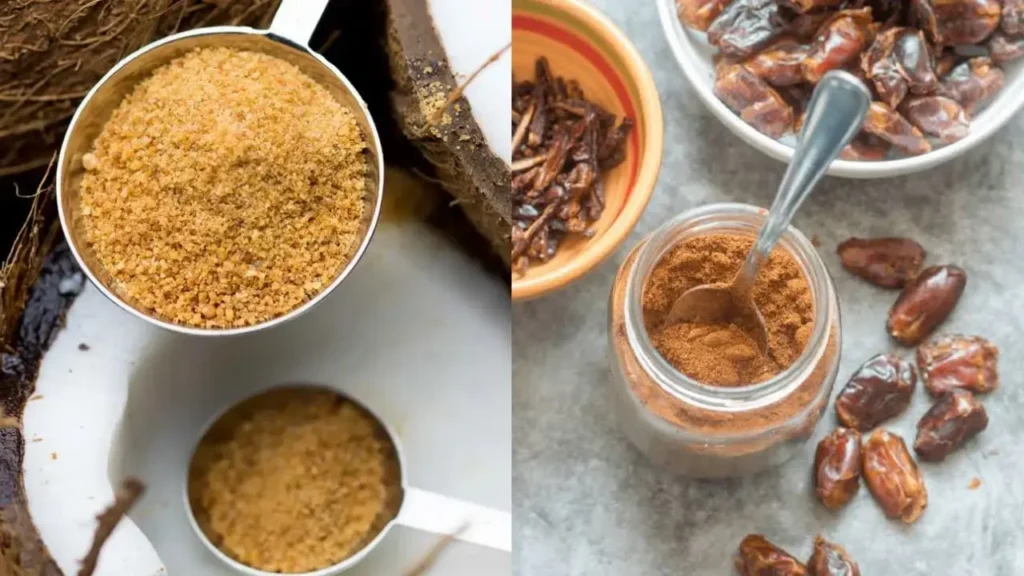
| Direct Answer: Coconut Sugar vs Date Sugar — Key Differences Coconut sugar and date sugar are both minimally processed natural sweeteners, but they differ fundamentally in source, composition, and baking behavior. Coconut sugar (from coconut palm flower sap) is granulated, dissolves completely, has a GI of approximately 35, and behaves similarly to brown sugar in cooking and baking. Date sugar (from dried, ground whole dates) is granulated but does NOT fully dissolve, retains the full fiber and mineral content of whole dates, has a GI of approximately 42-55, and creates a denser, moister, slightly grainy texture in baked goods. For baking where clean dissolution and smooth texture matter (cakes, cookies), coconut sugar performs better. For nutritional density and whole-food positioning, date sugar has more fiber and minerals. Neither can replace the other 1:1 without adjustment. |
When it comes to natural sweeteners, coconut sugar and date sugar are often compared — and frequently confused.
Both are granulated, both are brown, both are marketed as 'healthier alternatives' to refined white sugar, and both appear in health food aisles and clean label food products.
But underneath their similar appearance, they are quite different ingredients with different nutritional profiles, very different baking behaviors, and different strengths depending on your application.
This comparison is written from the perspective of a certified coconut sugar producer.
Browse our organic coconut sugar from Indonesia for specifications and sourcing information.
What Are They? Origins and Production

| Coconut Sugar | Date Sugar | |
| Source | Sap from coconut palm flower buds (Cocos nucifera) | Whole dried dates (Phoenix dactylifera) — ground into granules |
| Production process | Sap collected, gently evaporated, crystallized into granules — minimal processing | Dates dried, pitted, and ground — essentially dehydrated whole fruit |
| Processing level | Minimal — single-step evaporation and granulation | Very minimal — mechanical drying and grinding only |
| What's retained | Natural sugars from sap + inulin fiber + trace minerals | ALL components of whole date: fiber, minerals, antioxidants, natural sugars |
| Primary growing region | Indonesia, Philippines, Thailand | Middle East, North Africa, California (USA) |
| Commercial availability | Widely available globally — major B2B supplier network | More limited — primarily US and specialty market availability |
| Price per kg (retail) | USD 5-12/kg retail | USD 8-18/kg retail (typically more expensive) |
Understanding how coconut sugar is produced from coconut palm flower sap through minimal processing explains why it retains its natural trace minerals and inulin fiber — and why it is classified as an unrefined sugar despite being granulated.
Nutritional Comparison: Coconut Sugar vs Date Sugar
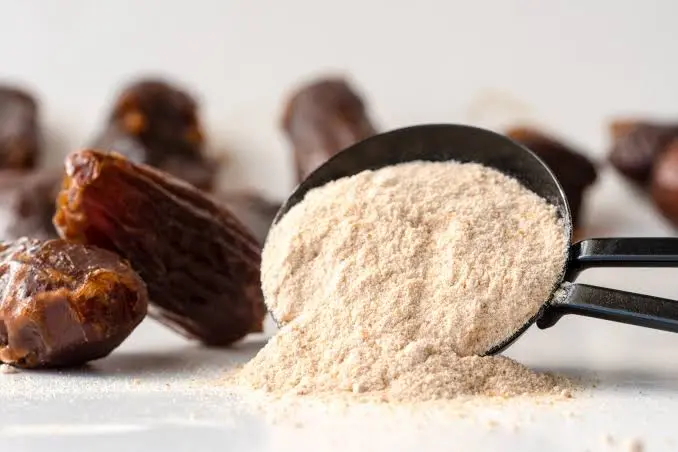
| Nutrient (per 100g) | Coconut Sugar | Date Sugar | Winner |
| Calories | ~375 kcal | ~282 kcal | Date sugar (lower calorie per 100g — due to higher fiber) |
| Total carbohydrates | ~92-95g | ~75g | Date sugar (lower net carbs when fiber is accounted for) |
| Dietary fiber | ~1-3g (inulin) | ~8-10g (from whole date flesh) | Date sugar (significantly more fiber) |
| Sugar content | ~70-80% sucrose + fructose/glucose | ~65-70% natural date sugars | Similar — both primarily natural sugars |
| Glycemic Index (GI) | ~35 (low GI) | ~42-55 (low to medium) | Coconut sugar (lower GI — inulin slows glucose absorption) |
| Glycemic Load (per 2 tsp serving) | ~2.7 (low) | ~2.5-3.5 (low to moderate) | Similar at typical serving sizes |
| Potassium | ~1,030 mg | ~696 mg | Coconut sugar (higher potassium) |
| Iron | ~2.5 mg | ~1.0 mg | Coconut sugar (higher iron) |
| Magnesium | ~29 mg | ~54 mg | Date sugar (higher magnesium) |
| Antioxidants | Moderate (polyphenols from sap) | High (whole date antioxidants retained) | Date sugar (higher antioxidant content) |
| Inulin (prebiotic fiber) | 1-3% | Minimal (date fiber is primarily insoluble) | Coconut sugar for prebiotic benefit specifically |
| Processing | Minimal — evaporation only | Minimal — drying and grinding only | Tie — both are minimally processed |
| The honest nutritional verdict Date sugar wins on fiber content and antioxidants — it is essentially ground whole fruit, which means it retains more of the nutritional complexity of the original food. Coconut sugar wins on glycemic index (lower GI due to inulin) and potassium content. For most people choosing between the two for everyday sweetening, the nutritional difference is relatively small at typical serving sizes (1-2 teaspoons in a beverage or recipe). The more meaningful difference is in baking behavior and application suitability — which has nothing to do with nutrition. |
Glycemic Index Deep Dive: Which Raises Blood Sugar Less?
Coconut sugar has a well-documented GI of approximately 35 — significantly lower than white sugar (GI ~65) and brown sugar (GI ~64).
This low GI is attributed to the inulin fiber naturally present in coconut palm sap, which slows glucose absorption in the small intestine.
For a complete scientific breakdown of coconut sugar's GI and what it means for label claims, see our dedicated article on the glycemic index of coconut sugar.
Date sugar's GI is more variable — published figures range from 42 to 55 depending on the date variety (Medjool, Deglet Nour, Barhi have different sugar compositions) and preparation method.
Date sugar's higher fiber content (8-10g per 100g vs coconut sugar's 1-3g) partially offsets its higher sugar content, resulting in a more moderate glycemic response than the raw sugar content might suggest.
| Sweetener | GI | Glycemic Load (2 tsp) | Primary GI-Lowering Mechanism |
| Coconut sugar | ~35 (Low) | ~2.7 | Inulin fiber slows glucose absorption |
| Date sugar | ~42-55 (Low-Medium) | ~2.5-3.5 | Insoluble fiber slows gastric emptying |
| Brown sugar | ~64 (Medium) | ~4.5 | None — refined product |
| White sugar | ~65 (Medium) | ~4.6 | None — refined product |
| Honey | ~58-85 (Medium-High) | ~4.0-6.0 | Fructose component (slower metabolism) |
| Maple syrup | ~54 (Low-Medium) | ~3.8 | Moderate — some polyphenol effect |
Baking Behavior: The Most Important Practical Difference
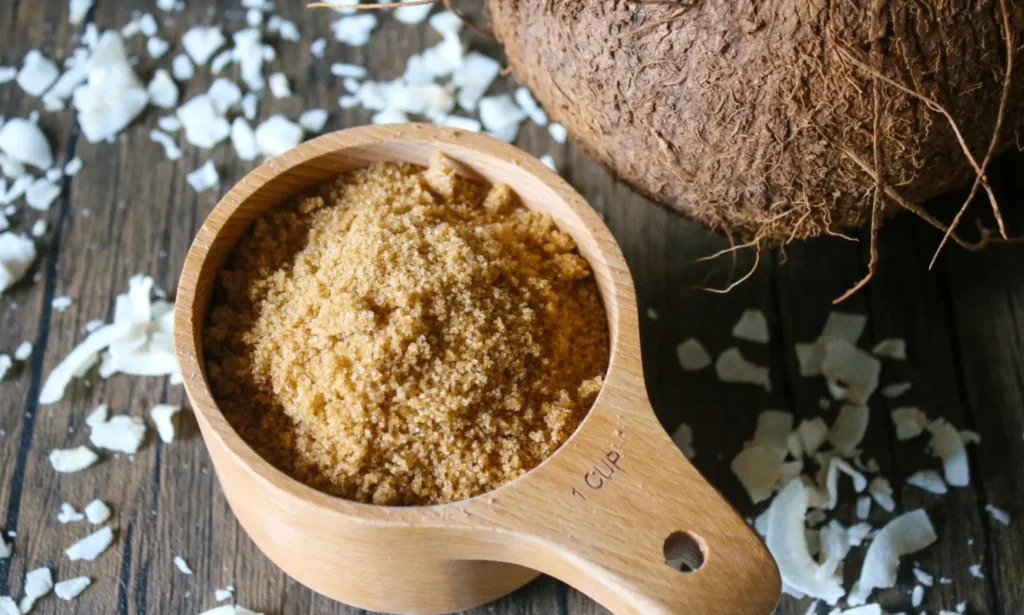
For home bakers and food product developers, the baking behavior difference between coconut sugar and date sugar is far more significant than the nutritional difference.
They do not behave the same way in recipes — and substituting one for the other without adjustment will produce noticeably different results.
The Key Difference: Date Sugar Does Not Dissolve
This is the most critical practical distinction. Coconut sugar dissolves completely in liquids and batters at room temperature and baking temperatures — behaving essentially like granulated brown sugar.
Date sugar does NOT fully dissolve. Because it is ground whole fruit (including fiber), it retains its fibrous particle structure even when heated. This means:
- In beverages: Coconut sugar dissolves in hot coffee or tea within 30-60 seconds. Date sugar will partially dissolve but may leave gritty particles at the bottom of the cup — especially in cold beverages.
- In cake batters: Coconut sugar incorporates smoothly when creamed with butter or mixed into batter. Date sugar creates a denser, slightly grainy texture in fine-crumb cakes.
- In cookies: Coconut sugar produces crispy edges and chewy centers — similar to brown sugar. Date sugar produces a denser, moister, chewier cookie with slightly visible sugar particles.
- In frosting: Coconut sugar (powdered in a blender) works in frosting. Date sugar cannot be used in traditional buttercream frosting even when powdered — the fiber content creates unacceptable texture.
Baking Substitution Table
| Application | Coconut Sugar | Date Sugar | Substitution Notes |
| Hot beverages | ✅ Dissolves fully | ⚠️ Partially dissolves | Use coconut sugar for cleaner beverage sweetening |
| Cold beverages | ✅ Dissolves with stirring | ❌ Does not dissolve well | Coconut sugar strongly preferred |
| Cakes and muffins | ✅ Excellent — smooth crumb | ⚠️ Good — denser texture | If substituting: add 1-2 tbsp extra liquid with date sugar |
| Cookies | ✅ Chewy center, crispy edge | ✅ Dense, moist, chewy | Both work — different texture profile |
| Brownies | ✅ Deep caramel flavor | ✅ Rich, fudgy, date notes | Both excellent — personal preference |
| Granola | ✅ Excellent caramelization | ✅ Good — slight graininess | Both work well |
| Frosting/icing | ⚠️ Must powder first | ❌ Not suitable | Coconut sugar only (powdered) |
| Sauces and glazes | ✅ Dissolves cleanly | ⚠️ Leaves fiber particles | Coconut sugar preferred for smooth sauces |
| No-bake energy balls | ✅ Good binder | ✅ Excellent binder (fiber) | Date sugar excellent here — fiber aids binding |
| Fermentation (kombucha) | ✅ Fully fermentable | ⚠️ Fiber may affect fermentation | Coconut sugar preferred for consistent fermentation |
For complete coconut sugar baking substitution ratios and adjustment guides for white sugar, brown sugar, and liquid sweeteners, see our comprehensive guide on coconut sugar substitutes in baking.
Flavor Profile: What Do They Taste Like?

| Flavor Attribute | Coconut Sugar | Date Sugar |
| Primary flavor note | Rich caramel-butterscotch with earthy undertone | Caramel-toffee with distinctive date fruit note |
| Sweetness intensity | ~85-95% of white sugar | ~80-90% of white sugar |
| Aftertaste | Clean, mild caramel | Distinct date/dried fruit note — more complex |
| Distinctiveness in recipes | Subtle — integrates well without dominating | More distinctive — date note detectable in finished product |
| Pairs best with | Chocolate, coffee, vanilla, spices, tropical fruit | Chocolate, cinnamon, nut butters, tahini, Middle Eastern flavors |
| Works less well with | Very light, delicate flavors (mild vanilla, lemon curd) | Light citrus, very neutral-flavored products |
For Food Manufacturers: Which Is More Practical at Scale?
For food brands and food manufacturers evaluating both sweeteners as production ingredients, the practical considerations go beyond nutrition and flavor.
Our articles on coconut sugar vs cane sugar for food manufacturing and applications of coconut sugar in the food industry cover the full technical and commercial picture for coconut sugar specifically.
| Factor | Coconut Sugar | Date Sugar | Advantage |
| Dissolution in production | Complete — no process modification needed | Incomplete — requires recipe adjustment or specialized application | Coconut sugar |
| Supply chain availability | Global — Indonesia produces ~70% of world supply, B2B suppliers well-established | Limited — primarily US and Middle East specialty suppliers | Coconut sugar |
| Price stability | Relatively stable — established commodity | More variable — specialty agricultural product | Coconut sugar |
| Organic certification | USDA NOP, EU Organic widely available | USDA NOP available from some suppliers | Tie — both certifiable |
| BRCGS certified suppliers | Multiple BRCGS Grade A certified Indonesian suppliers | Limited BRCGS certified date sugar suppliers | Coconut sugar |
| Label claims supported | Refined sugar-free, natural, unrefined, low GI ingredient | Refined sugar-free, whole food sweetener, high fiber | Different claims — both valuable |
| MOQ for FCL | ~14-16 MT (20ft FCL) — widely available | Smaller volumes typically — limited FCL availability | Coconut sugar for large-scale production |
| Consistency batch-to-batch | High — standardized production | More variable — depends on date variety and crop year | Coconut sugar |
| Application suitability | Beverages, bakery, confectionery, granola, sauces — broad | Bars, baked goods, dry mixes — more limited | Coconut sugar (broader) |
When to Choose Coconut Sugar
- Beverages and sauces: When clean dissolution is required — coconut sugar dissolves completely, date sugar does not.
- Smooth-textured baked goods: Cakes, cupcakes, muffins where a fine, consistent crumb is important.
- Food manufacturing at scale: More consistent supply, wider certified supplier network, lower MOQ barriers.
- Low-GI positioning: Coconut sugar's GI of ~35 is lower than date sugar's ~42-55 — stronger low-GI claim.
- Clean dissolution in fermentation: Coconut sugar is fully fermentable without fiber interference — preferred for kombucha and kefir.
- Refined sugar-free + unrefined: Both qualify, but coconut sugar's liquid-to-granule processing is more universally recognized as 'unrefined.'
When to Choose Date Sugar
- Maximum nutritional density: Date sugar retains significantly more fiber (8-10g vs 1-3g per 100g) and antioxidants from the whole fruit.
- Whole food positioning: Date sugar is literally ground dried fruit — 'whole food sweetener' claim is uniquely authentic for date sugar.
- No-bake energy balls and bars: The fiber content actually helps with binding — date sugar is structurally functional here.
- Recipes where date flavor is complementary: Middle Eastern flavors, tahini cookies, nut butter bars — date flavor is a positive contribution.
- Specific health positioning: Higher antioxidant content and significantly higher fiber — stronger nutrition story for fiber-forward positioning.
| Source certified coconut sugar for your product formulation Global Coco Sugar supplies BRCGS Food Safety Grade A certified organic and conventional coconut sugar from Indonesia — widely available in FCL quantities with full COA documentation. R&D samples available for product development trials. Request Samples or a Bulk Quote >>> View Our Coconut Sugar Range & Specifications >>> |
Conclusion: Different Sweeteners for Different Jobs
Coconut sugar and date sugar are not competing for the same role — they each have distinct strengths that make them the better choice in specific applications.
Coconut sugar is more versatile across a broader range of cooking, baking, and beverage applications due to its complete dissolution and clean caramel flavor.
Date sugar offers superior fiber and antioxidant content for applications where whole-food positioning and binding properties are valued.
As a coconut sugar producer, our honest recommendation: if your recipe or product requires a fully-dissolving granulated natural sweetener with low GI and broad application compatibility, coconut sugar is the better choice.
If your recipe specifically benefits from higher fiber content and a whole-food sweetener claim — and your application tolerates the partial dissolution and distinct date flavor — date sugar may serve you better.
Both are genuine improvements over refined white sugar.
Frequently Asked Questions
Is coconut sugar or date sugar healthier?
Both are less refined alternatives to white sugar, but they differ nutritionally. Date sugar contains more fiber because it is made from whole dried dates, while coconut sugar is often valued for its lower glycemic index. The better choice depends on your nutritional priority and application.
Can I substitute date sugar for coconut sugar in baking?
Yes, but recipe adjustments may be needed. Date sugar does not dissolve as fully as coconut sugar because it contains fruit fiber, so it can create a denser texture. It works best in bars, cookies, and recipes where a slightly grainier texture is acceptable.
What is the glycemic index of coconut sugar vs date sugar?
Coconut sugar generally has a lower glycemic index than date sugar. Both are typically lower than refined white sugar, but actual values may vary depending on product type, processing, and serving size.
Which is better for baking: coconut sugar or date sugar?
Coconut sugar is generally more versatile for baking because it dissolves and behaves more like brown sugar. Date sugar is better for recipes where its fiber content and natural fruit flavor are beneficial, such as energy bars or dense baked goods.
Is date sugar the same as coconut sugar?
No. Coconut sugar is made from coconut palm sap, while date sugar is made from ground dried dates. They differ in flavor, texture, dissolution, and baking performance, so they are not always directly interchangeable.


